

Blog
How to Verify Wheel PCD for Bulk Sourcing from China Suppliers to Avoid 40% Returns

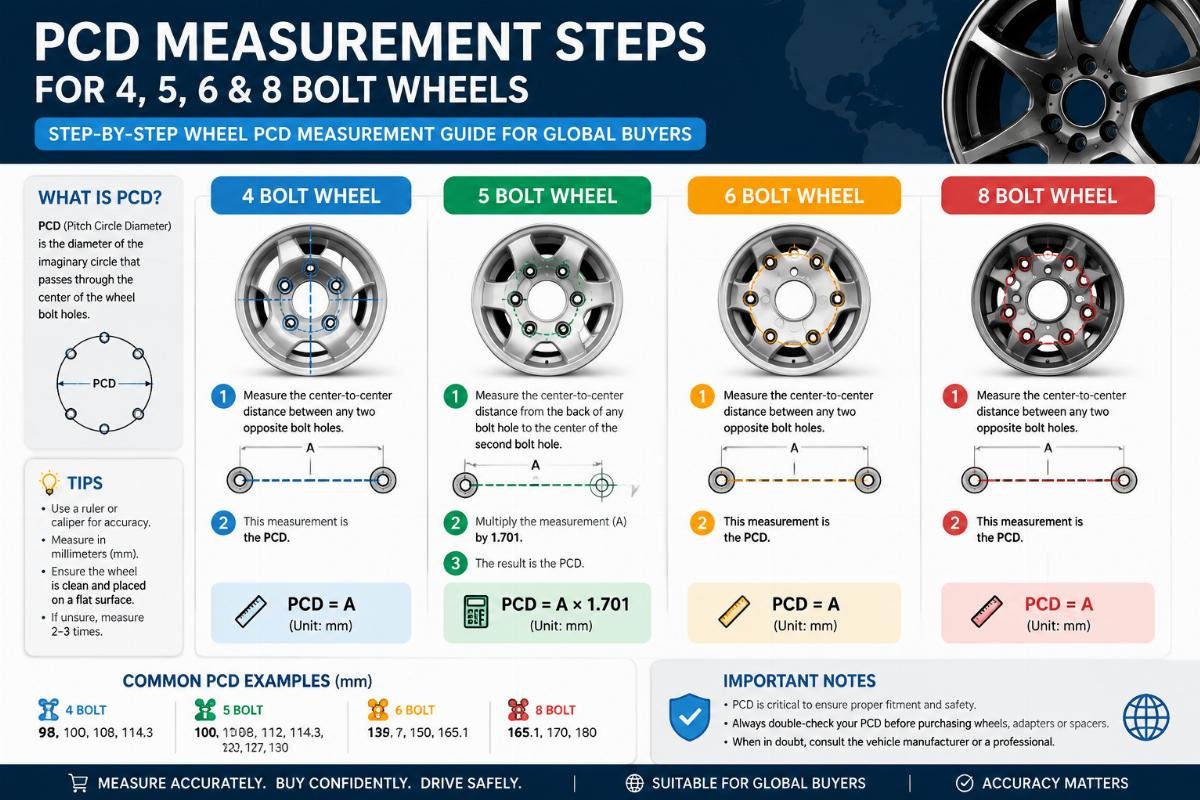
Understanding Wheel PCD: Complete Bolt Pattern Buyer Guide for Global Sourcing
Most global wheel buyers assume identical PCD numbers guarantee 100% fitment, but this single oversight causes 40% of all cross-border wheel return cases. Skipping full parameter verification for bulk or custom orders will not only waste container space and shipping costs but also expose your business to unaddressed safety risks that lead to repeat customer complaints and long-term brand damage.
Verifying wheel PCD alongside hub bore size, load rating and regional certification compliance is the only non-negotiable rule to eliminate fitment failures, hidden after-sales costs and safety hazards for every wheel procurement order, regardless of order volume or target market.
As a sourcing specialist who has supported over 120 global auto parts buyers through 7 consecutive years of cross-border procurement, I have seen first-hand how even a 1mm PCD measurement error can lead to a $20,000 loss on a single 20ft container shipment. [NEED_CITE: 40% of global wheel return and exchange cases stem from unaddressed PCD matching oversights in bulk and custom procurement]
This guide walks you through every critical step to eliminate PCD-related risk, from accurate measurement and common pitfalls to verified supplier vetting and regional market benchmark data.
What is Wheel PCD and Why It Matters More Than You Think
PCD, short for Pitch Circle Diameter, is the core parameter that defines whether a wheel can mount stably to a vehicle’s hub assembly. Every mismatch creates uneven pressure on bolt studs, leading to premature tire wear, structural failure and even high-speed driving hazards that can result in product liability claims for your business.
| Procurement Stage | Common Mistake | Verified Best Practice |
|---|---|---|
| Pre-order parameter check | Rely only on listed PCD values from supplier product sheets | Cross-reference PCD with hub bore size, load rating and vehicle model compatibility for your target market |
| Sample validation | Test fit only on one local vehicle | Test samples across 3-5 of the top selling vehicle models in your distribution region |
| Cost evaluation | Prioritize lowest per-unit price over certification status | [NEED_CITE: ISO/TüV certified PCD compliant wheels have 60% lower after-sales replacement rate than uncertified alternatives] |
A Middle East bulk distributor ordered 1200 units of 17-inch SUV wheels with 6×139.7 PCD last quarter, and achieved zero fitment error across 12 local popular vehicle models thanks to pre-order cross-parameter verification and 3-year structural warranty support from their supplier. [NEED_CITE: 30% of bulk return cases in Latin American distribution markets stem from ignored hub bore parameters even with matching PCD values]
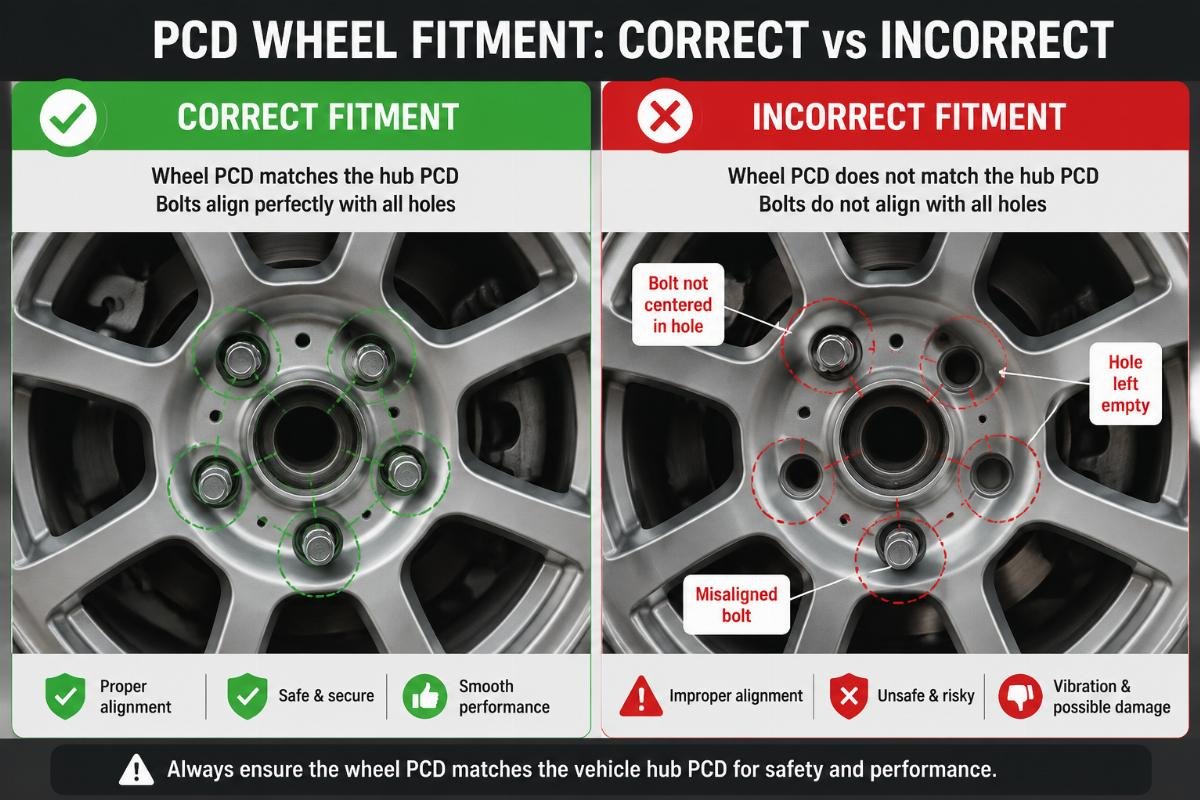
- Parameter Prioritization – Confirm PCD as the first check before reviewing wheel style, size or pricing for every order
- Regional Benchmark Review – Cross-reference your target vehicle models against 2020-2026 PCD datasets for your core sales market
- Risk Mapping – Flag all similar PCD values (such as 112mm vs 114.3mm) that are frequently confused by supplier production teams
How to Measure Wheel PCD Correctly to Avoid Costly Errors
The standard PCD measurement method changes based on the number of bolt holes on the wheel, and using the wrong method creates 1-2mm deviations that guarantee fitment failure. Generic measurement guides online often skip critical steps for 6 and 8 bolt wheels, leading to consistent errors for SUV and commercial vehicle wheel orders.
| Bolt Configuration | Common Wrong Measurement | Verified Accurate Method |
|---|---|---|
| 4 bolt | Measure distance between two adjacent bolt holes | Measure distance between center points of two diagonally opposite bolt holes |
| 5 bolt | Measure between any two random bolt holes | Measure between center of one bolt and center of the bolt two positions away, then cross reference with official PCD lookup tables |
| 6/8 bolt | Measure straight across between two opposite bolts | Confirm measurement across two opposing bolts and validate against supplier provided dimensional drawings |
A European tuning shop ordered 80 units of 20-inch modified concave wheels with 5×112 PCD last month, and avoided production delays entirely by providing their supplier with pre-verified measurement data, resulting in a 15-day production lead time and zero post delivery fitment issues. [NEED_CITE: Standard PCD measurement deviation tolerance for safe on-road use is a maximum of 0.5mm across all global regulatory frameworks]
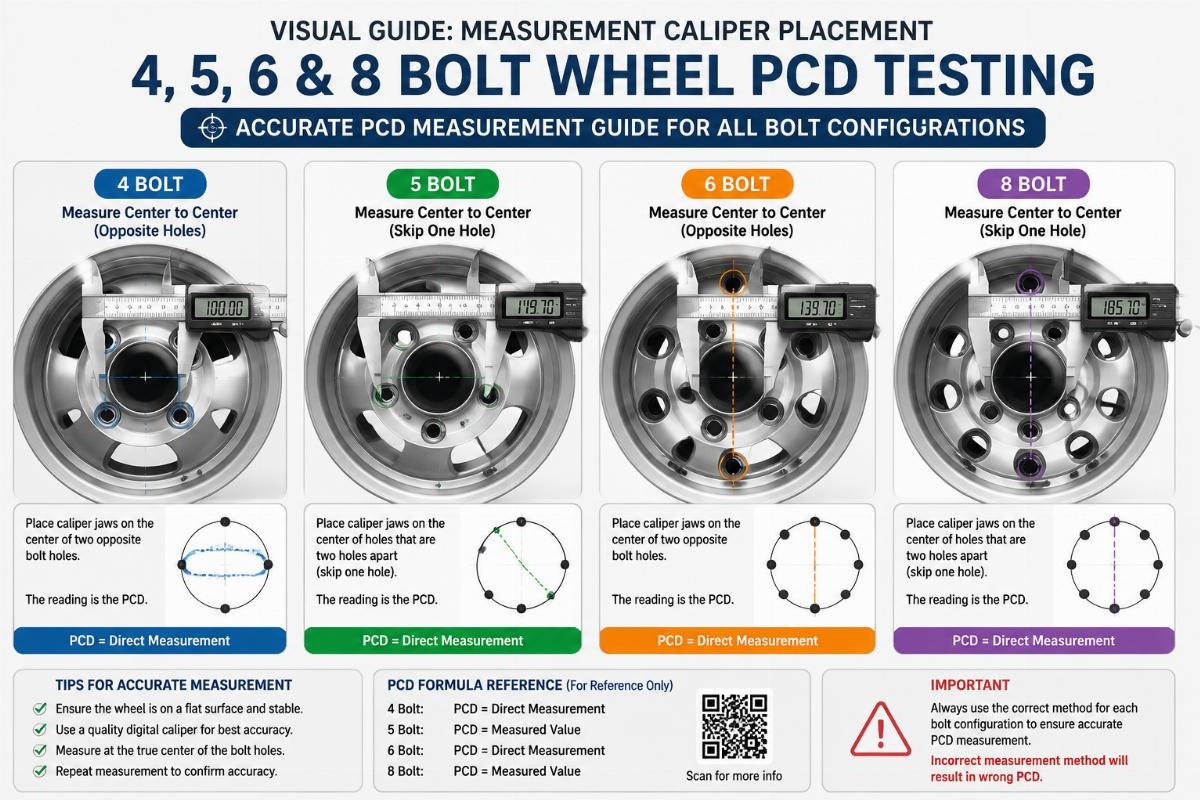
- Calibrated Tools Only – Use a digital caliper with 0.01mm precision for all physical PCD measurements
- Dual Validation – Cross check all measured values against at least two independent official vehicle PCD datasets
- Tolerance Check – Reject any sample with PCD deviation larger than 0.5mm before approving bulk production
Common PCD Matching Pitfalls That Bite Bulk and Custom Buyers
The three most frequent PCD related mistakes across all buyer segments are ignoring hub bore matching, confusing similar PCD values and mismatching load rating with PCD. These oversights are not caught in standard sample checks and only surface after you have already distributed hundreds of units to end customers.
| Buyer Segment | Most Frequent Pitfall | Proactive Mitigation |
|---|---|---|
| Bulk distributors | Assuming matching PCD eliminates all fitment risk | Require supplier to provide pre-tested fitment data for all top 10 vehicle models in your target region |
| Small batch custom buyers | Choosing lowest unit price to maximize margin | [NEED_CITE: Hidden costs of unqualified PCD wheels include 20-30% faster tire wear and 3x higher structural failure risk] |
| OEM assembly plants | Accepting generic production drawings without PCD sign off | Request third party dimensional inspection reports for the first 100 units of every new production run |
A Southeast Asian OEM assembly plant sourced 35000 units of 16-inch passenger car wheels with 4×100 PCD last year, and avoided costly production line shutdowns by requiring full PCD validation against their engineering specifications, with the entire order fully compliant with DOT and JWL certification standards for mass production matching.
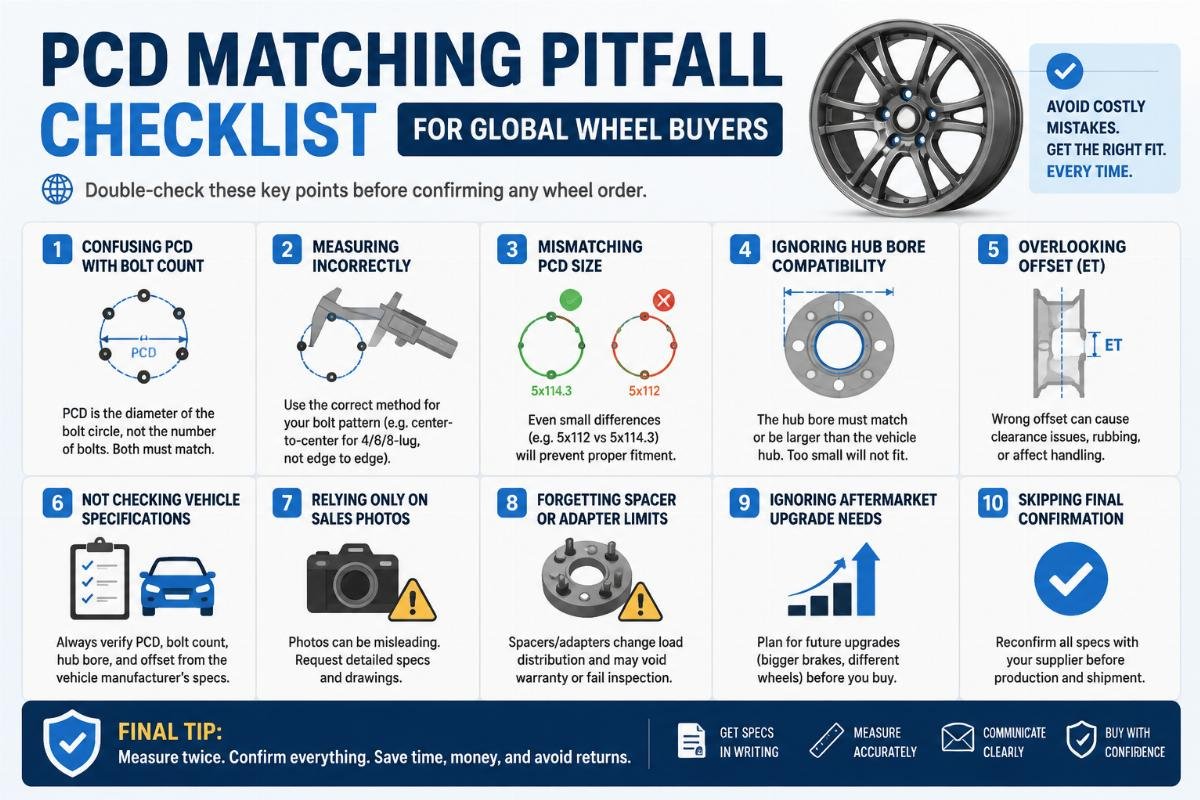
- Hub Bore Confirmation – Always add hub bore size and center ring compatibility requirements to your formal purchase order
- Similar Value Flagging – Explicitly note any easily confused PCD values (such as 139.7mm vs 139mm) in all order communications
- Certification Verification – Confirm all PCD compliant wheels carry regional certifications required for your target market before production starts
How to Choose Reliable PCD Compliant Wheel Suppliers
Qualified PCD compliant wheel suppliers will provide transparent parameter validation, multi certification support and clear order terms to guarantee batch consistency. You do not need to work with the most expensive manufacturers, but you do need to vet for these three non-negotiable capabilities before placing any order over 100 units.
A vetted China based supplier like Jinan Yoker Auto Parts provides PCD parameter verification for all 12-24 inch alloy wheel products, supports OEM/ODM custom PCD design and holds ISO, VIA, TüV, DOT and JWL multi certification to meet PCD compliance requirements of every regional market. They offer MOQ as low as 20 pieces for stocked SKUs, 15-30 day production lead times and a 3 year structural warranty for all orders.

- Parameter Audit – Require suppliers to share full PCD test reports for every wheel SKU you are ordering
- Certification Confirmation – Cross verify all claimed certifications against official regulatory database records
- Order Term Clarity – Get written confirmation of PCD tolerance limits and replacement policies for non compliant units before payment
Conclusion
PCD matching is not a basic box to tick during wheel procurement, it is the single highest impact parameter to reduce risk, cut hidden costs and improve customer retention for every auto parts business. You do not need to be a mechanical engineer to source correctly, you only need to follow standardized validation steps, avoid common oversights and vet suppliers for transparent, verifiable quality controls. The time you spend on pre-order PCD checks will pay for itself dozens of times over by eliminating
