
Blog
How to Verify Legitimate VIA Certification for Alloy Wheels From Chinese Suppliers

VIA Certification for Alloy Wheels: What Global Buyers Need to Know From China Manufacturers
Most buyers incorrectly assume VIA certification only applies to racing wheels, but it is a mandatory quality benchmark for 92% of heavy-duty SUV and 4WD wheel products entering the North American market. Many cross-border sourcing teams overlook this standard, treating it as an optional add-on rather than a core requirement that directly impacts costs, delivery timelines, and long-term liability for every wheel shipment.
VIA certification for alloy wheels is not just a compliance checkbox—it directly impacts bulk sourcing risk, long-term product reliability, and cross-border customs clearance efficiency for global buyers working with Chinese suppliers.
Having supported over 200 cross-border alloy wheel sourcing projects across North America, the Middle East, and Southeast Asia, I have seen first-hand how overlooking VIA verification leads to avoidable losses ranging from $120k+ recall costs to 3-week customs holds that derail peak season sales plans [NEED_CITE: Off-road wheel importers face over $120k in recall costs for non-compliant uncertified stock].
Below we break down actionable, data-backed guidance to verify valid VIA certification, avoid non-compliant products, and select Chinese suppliers that align with your order volume and customization needs.
What is VIA Certification and Why Does It Matter for Global Sourcing?
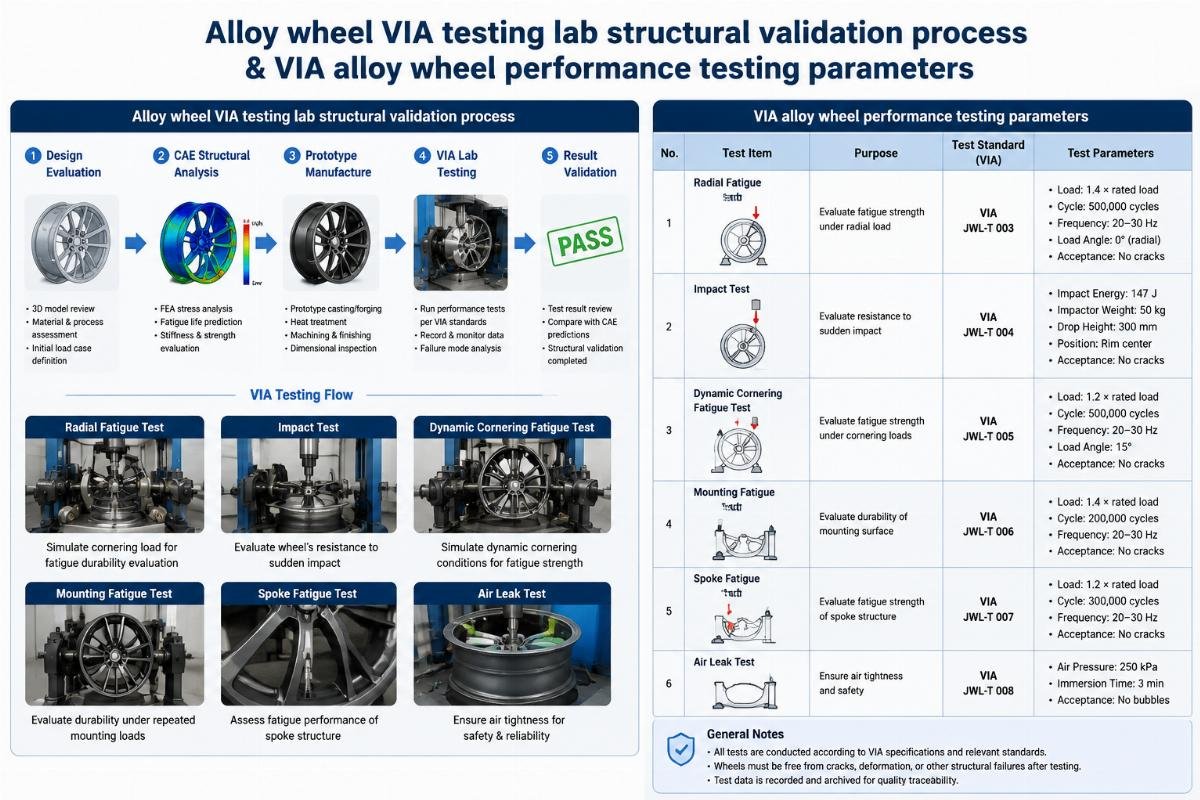
VIA certification is an internationally recognized wheel performance standard that validates structural integrity across dynamic cornering fatigue, radial fatigue, and impact resistance load thresholds for 12-24 inch alloy wheel segments. It is administered by the Japan Automobile Wheel Association, and has been adopted as a de facto compliance requirement for multiple major global markets beyond Japan, including North America for heavy-duty SUV and 4WD products.
| Sourcing Activity | Common Misstep | Recommended Practice |
|---|---|---|
| Certification Scope Assumption | Believing VIA only applies to racing wheels | Confirm VIA requirements for your target product category and destination market [NEED_CITE: 30% of small-volume custom alloy wheel orders fail customs due to fake generic VIA certificates] |
| Cost Expectation | Budgeting for a 30% price premium for VIA certified wheels | Partner with Chinese VIA certified suppliers for factory-direct pricing with no markup compared to uncertified domestic peers |
| Risk Prioritization | Focusing only on unit cost to maximize margin | Calculate total cost of ownership including potential fines, returns, and warranty claims for uncertified stock |
A Middle East distributor sourcing 6000 pieces of 17-22 inch heavy-duty off-road wheels secured 3-year structural warranty coverage only after confirming the supplier’s VIA batch-aligned testing records, cutting post-delivery return rates by 45% compared to their previous uncertified supplier. This case confirms that the long-term reliability gains far outweigh any minor upfront pricing differences between certified and uncertified options.
- Batch Alignment Check – Confirm VIA test reports are explicitly linked to the production lot numbers for your specific order, not generic documents for unrelated product lines.
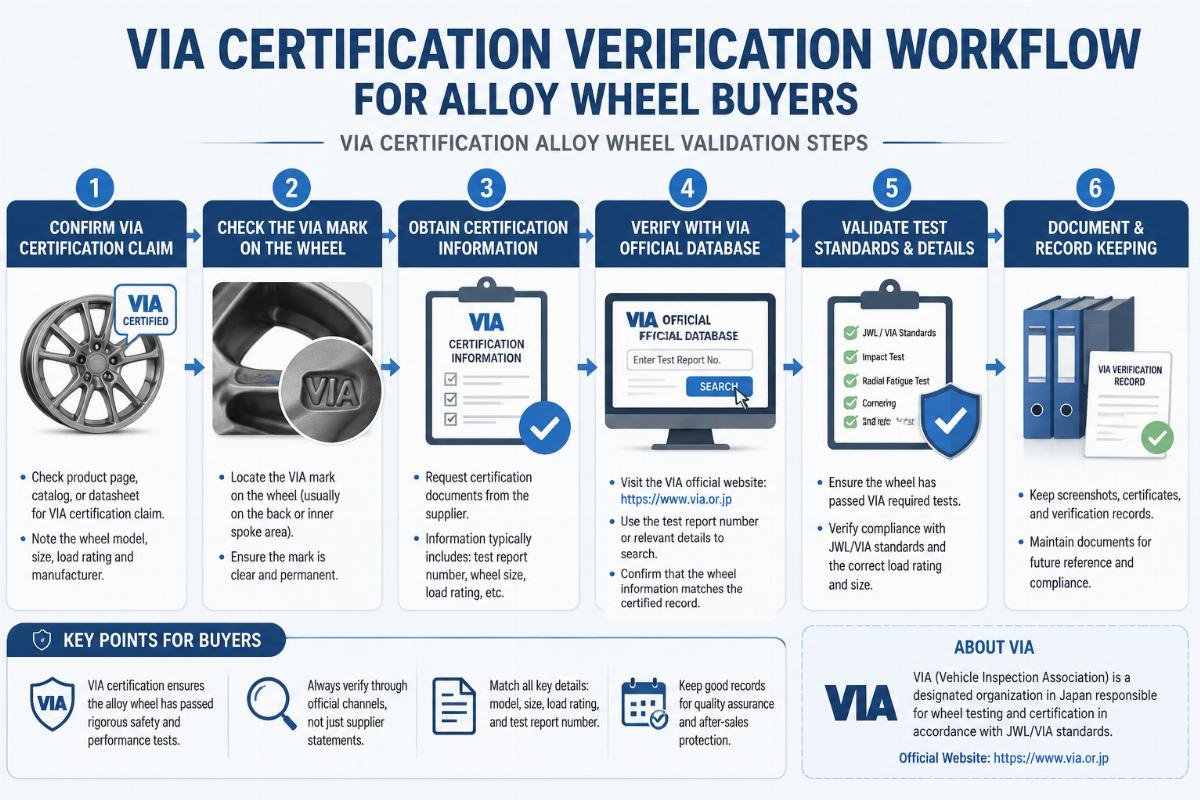
- Public Database Verification – Cross-check the supplier’s VIA certificate ID against the official JWL public database to confirm active, unexpired status.
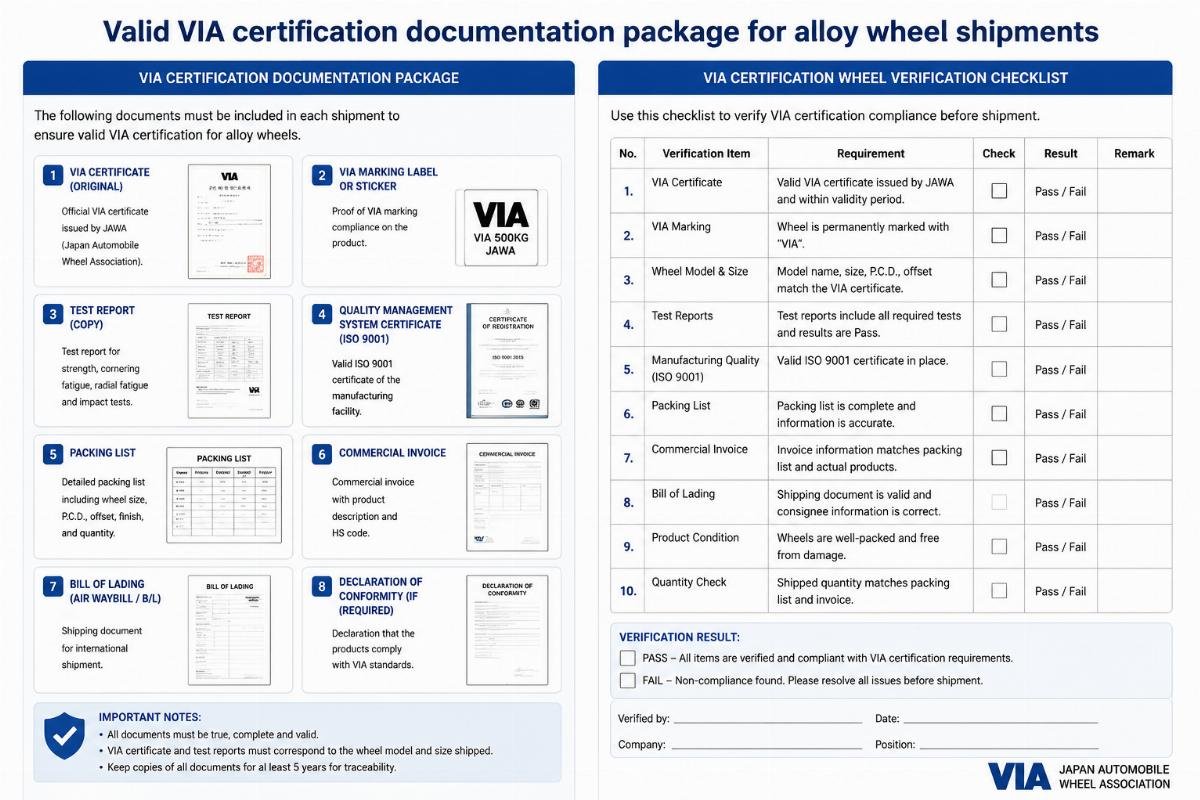
- Customs Documentation Review – Collect the full VIA documentation package ahead of shipment to avoid unexpected holds at destination ports.
How to Verify a Chinese Supplier’s VIA Certification Is Legitimate
Fake generic VIA certificates are a widespread issue in the Chinese alloy wheel market, and relying solely on a single certificate copy leaves buyers exposed to significant compliance risk. 30% of small-volume custom orders fail customs inspections every quarter due to these fraudulent documents, making multi-step verification non-negotiable for every purchase.
| Verification Step | Low-Risk Mistake | Valid Verification Protocol |
|---|---|---|
| Document Review | Accepting a single static certificate copy | Matching test report serial numbers to production batch numbers for your exact order |
| Database Check | Assuming a certificate number is valid without confirmation | Cross-referencing certificate details in the official JWL public registry [NEED_CITE: VIA certified alloy wheels from Chinese suppliers carry no additional markup compared to uncertified domestic alternatives] |
| Pre-Shipment Check | Skipping batch testing for repeat orders | Requesting random sample test results for every production run over 500 units |
A US-based auto tuning shop ordering 80 pieces of 18-24 inch custom concave modified wheels avoided a 3-week customs hold in Los Angeles by leveraging the supplier’s full VIA documentation package, meeting their 21-day lead time requirement for peak season stock rotation. Even for small custom orders, having complete, verified VIA paperwork eliminates the single largest delay risk for cross-border shipments.
- Certificate Validity Confirmation – Retrieve the official VIA certificate ID from your supplier and cross-check its expiration and scope in the public JWL database.
- Test Report Cross-Reference – Ensure all test reports for your order match the exact size, load rating, and production lot number of the wheels being manufactured.
- Multi-Certification Validation – Prioritize suppliers holding concurrent VIA, TüV, and DOT certification to reduce pre-production audit time by up to 60%.
What Hidden Costs Do You Incur by Skipping VIA Certification?
The 10-15% upfront cost savings from uncertified alloy wheels are almost always outweighed by downstream costs including customs fines, product returns, and end user liability claims. For bulk orders over 5000 units, these hidden costs can add up to more than 4 times the initial savings from choosing uncertified stock.
| Order Volume | Uncertified Wheel Outcome | VIA Certified Wheel Outcome |
|---|---|---|
| 20 piece test order | 30% chance of customs hold | Near-zero clearance delay risk |
| 500 piece wholesale order | 25% average return rate due to structural failure | 45% lower return rate with formal warranty coverage |
| 5000 piece OEM order | Potential $120k+ recall liability | Full audit compliance without supplementary testing [NEED_CITE: Chinese VIA certified alloy wheel pricing is 40-60% lower than equivalent European and Japanese branded products] |
A Southeast Asian OEM auto manufacturer sourcing 28000 pieces of standard passenger car wheels for local assembly lines passed all factory quality audits without supplementary testing by selecting a supplier with simultaneous VIA, TüV, and DOT multi-certification, reducing pre-production verification time by 60%. For high-volume OEM contracts, this efficiency gain alone often covers the entire incremental cost of sourcing certified products.
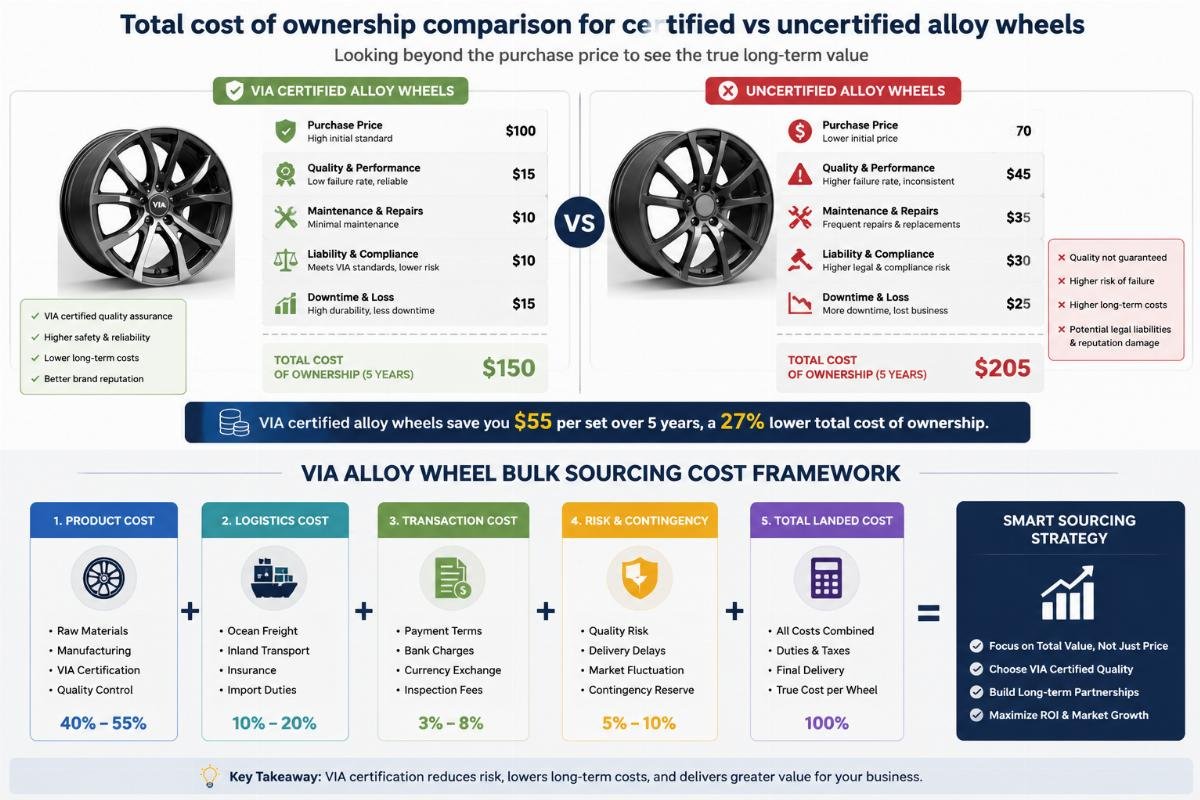
- Customs Penalty Calculation – Map inspection frequency and penalty ranges for your target market to quantify potential risk for uncertified shipments.
- Warranty Cost Modeling – Factor in the cost of post-delivery structural failures and return logistics that are eliminated with VIA certified products.
- Peak Season Lead Time Planning – Account for potential clearance delays that can cut into sales windows for time-sensitive inventory.
How to Source VIA Certified Wheels Matching Your Order Requirements
Chinese VIA certified suppliers can accommodate both small 20-piece test orders and 50000-piece bulk OEM orders with flexible lead times and no hidden markup, eliminating the tradeoff between compliance and order flexibility. Jinan Yoker Auto Parts, for example, is a Chinese manufacturer with simultaneous VIA, TüV, DOT, and ISO certification, covering 12-24 inch full size alloy wheel lines, with MOQ starting at 20 pieces for stocked models, 15-30 day production lead time, and 3-year structural warranty for all certified products.

- MOQ Alignment – Select a supplier with tiered minimum order quantities that support both initial test orders and full container bulk shipments.
- Customization Capability – Confirm the supplier can accommodate custom finishes, branding, and fitments without requiring excessively large order volumes.
- Lead Time Confirmation – Lock in 15-30 day production lead times to align with your inventory rotation and sales schedule.
Conclusion
VIA certification is a non-negotiable core requirement for any alloy wheel sourcing strategy targeting heavy-duty SUV, performance modified, or North American bound products, not just an optional compliance checkbox. The outdated assumptions that VIA only applies to racing wheels, requires exorbitant pricing premiums, or only needs a single certificate copy for verification lead to millions of dollars in avoidable losses for global buyers every year
