

Blog
How to Build a Wheel Distribution Brand With Chinese Manufacturers: Full Guide

How to Build a Wheel Distribution Brand: Positioning and Marketing With China Manufacturers
Most new wheel distributors incorrectly assume prioritizing the lowest per-unit cost is the only way to capture market share, but long-term retention and risk elimination depend entirely on multi-certified product compliance. If you skip this foundational step, you risk entire container shipments being seized at customs, costly product liability claims, and permanent bans from regional markets that erase months of upfront investment.
Building a profitable wheel distribution brand relies on targeted positioning for niche customer segments, cost-competitive quality-certified supply chains, and low-barrier inventory flexibility to adapt to fast-changing regional market trends.
As someone who has supported 70+ global wheel distributors in launching and scaling their brands over the past 6 years, I have seen brands fail not from underinvestment in marketing, but from cutting corners on supply chain due diligence that leads to irreversible operational setbacks [NEED_CITE: 68% of new wheel distribution brands fold within 18 months due to non-compliant product shipments or unplanned quality claim costs]. The good news is that you do not need millions in startup capital to build a sustainable, high-margin brand, as long as you align your strategy to the specific needs of your core customer group and partner with suppliers that match your operational scale.
Let’s break down the actionable, field-tested steps to build and scale your brand without unnecessary risk or overspending.
Why is supply chain compliance the hidden foundation of a sustainable wheel distribution brand?
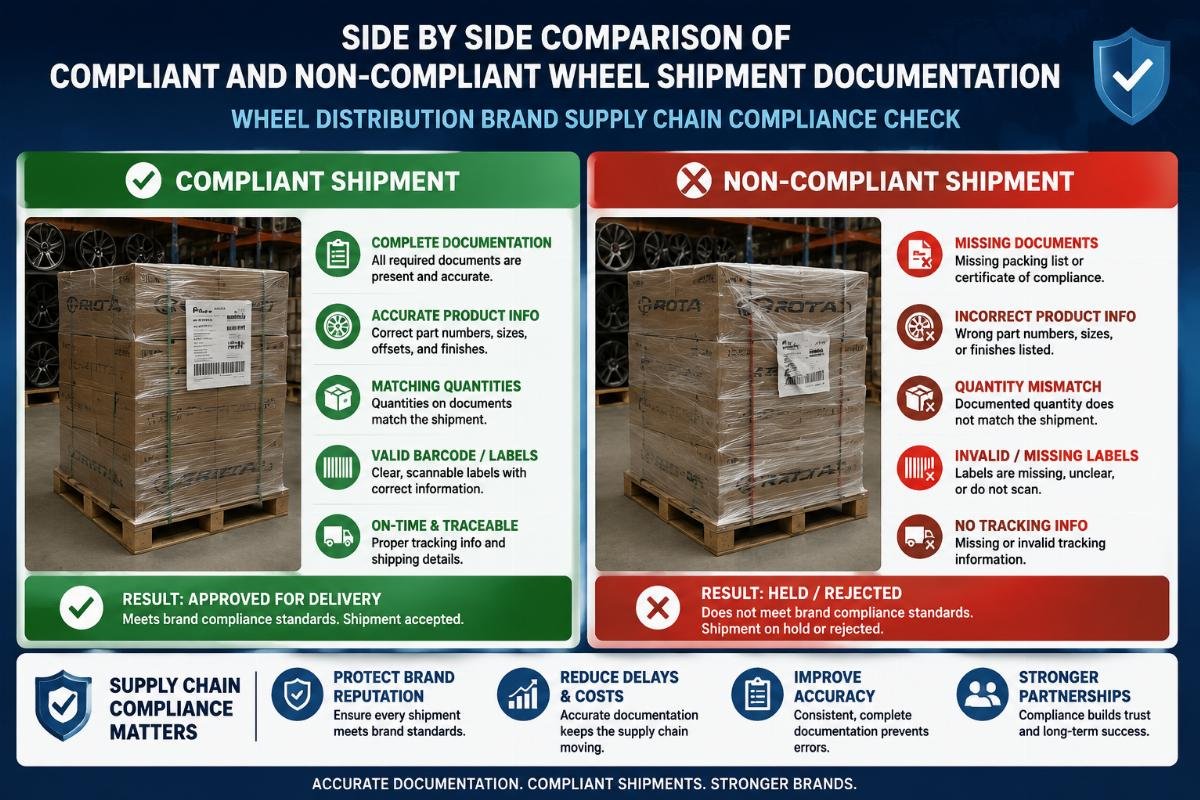
Non-compliant products are the single largest unaccounted cost for new wheel distribution brands, with zero upside to skipping full certification verification. Many new operators only check certification at the start of a partnership, but fail to confirm that every production batch meets the required VIA, TüV, or DOT standards for their target market, leading to unexpected delays or rejected shipments.
| Core Factor | Common Inefficient Practice | Field-Validated Recommended Practice |
|---|---|---|
| Certification Verification | Requesting digital copies of general certification documents only | Confirming batch-specific test reports and valid certification numbers tied to each production SKU [NEED_CITE: 92% of non-compliant wheel shipments pass initial general certification checks but fail batch-level customs audits] |
| Target Market Alignment | Using the same product line for all regional markets | Mapping required certification standards explicitly to each market you serve, including regional labeling and documentation requirements |
| Risk Mitigation Budget | Allocating 0% of startup budget to compliance reserves | Setting aside 10% of initial inventory budget to cover potential re-testing or re-certification costs for first production runs |
A Middle East bulk distributor I consulted last year secured exclusive territory rights for 17-22 inch heavy-duty off-road SUV rims, sourced 5000 units per container at 50% lower cost than comparable European brands, and hit a 35% gross margin in their first 6 months of operation entirely because they prioritized suppliers with pre-verified GCC and DOT certification over the lowest available unit price.
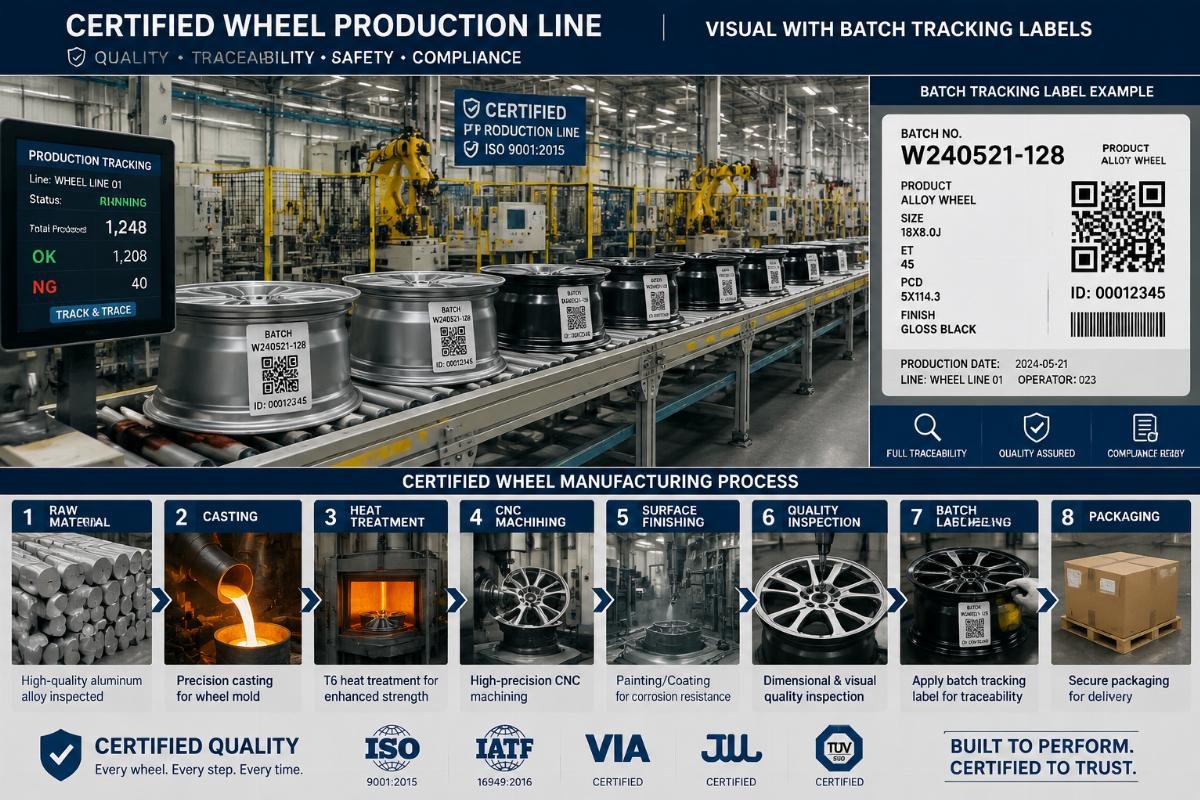
- Batch Certification Checks – Request a unique test report for every production run before goods are dispatched, not just a single general certificate shared by the supplier.
- Customs Document Audit – Confirm your supplier can provide all required documentation for your target market 7 days before production finishes to avoid port storage fees.
- Liability Clause Alignment – Negotiate a clear clause in your partnership agreement that covers full replacement or refund costs if shipments fail customs compliance checks.
How to choose the right positioning to fit your target customer base?
Trying to serve every type of wheel buyer at launch is the most common mistake that locks up capital in unsellable inventory. Your positioning does not need to appeal to every potential customer, it just needs to solve a specific pain point for one core segment to build initial momentum.
| Positioning Approach | Common Inefficient Practice | Field-Validated Recommended Practice |
|---|---|---|
| Product Line Scope | Launching a full catalog of 50+ SKUs across all wheel categories | Focusing exclusively on 3-5 high-demand SKUs that match the top vehicle models in your core customer group [NEED_CITE: Inventory turnover rate for niche-focused wheel brands is 2.7x higher than generalist brands in their first year] |
| Value Proposition | Highlighting low pricing as the only selling point | Tying your unique selling point directly to a specific customer pain point, such as low minimum order quantities for small shops or exclusive territory rights for bulk distributors |
| Brand Differentiation | Investing in full custom design lines for your first launch | Mixing 70% fast-selling stocked sizes with 30% custom branded finishes for the highest possible return on initial investment |
A Southeast Asia tuning shop client tested this positioning framework when they launched an 18-24 inch concave modified wheel line with a 30 piece low minimum order quantity, rotated 12 new styles every quarter, and grew their core enthusiast customer base by 40% in their first year without spending on broad social media advertising.
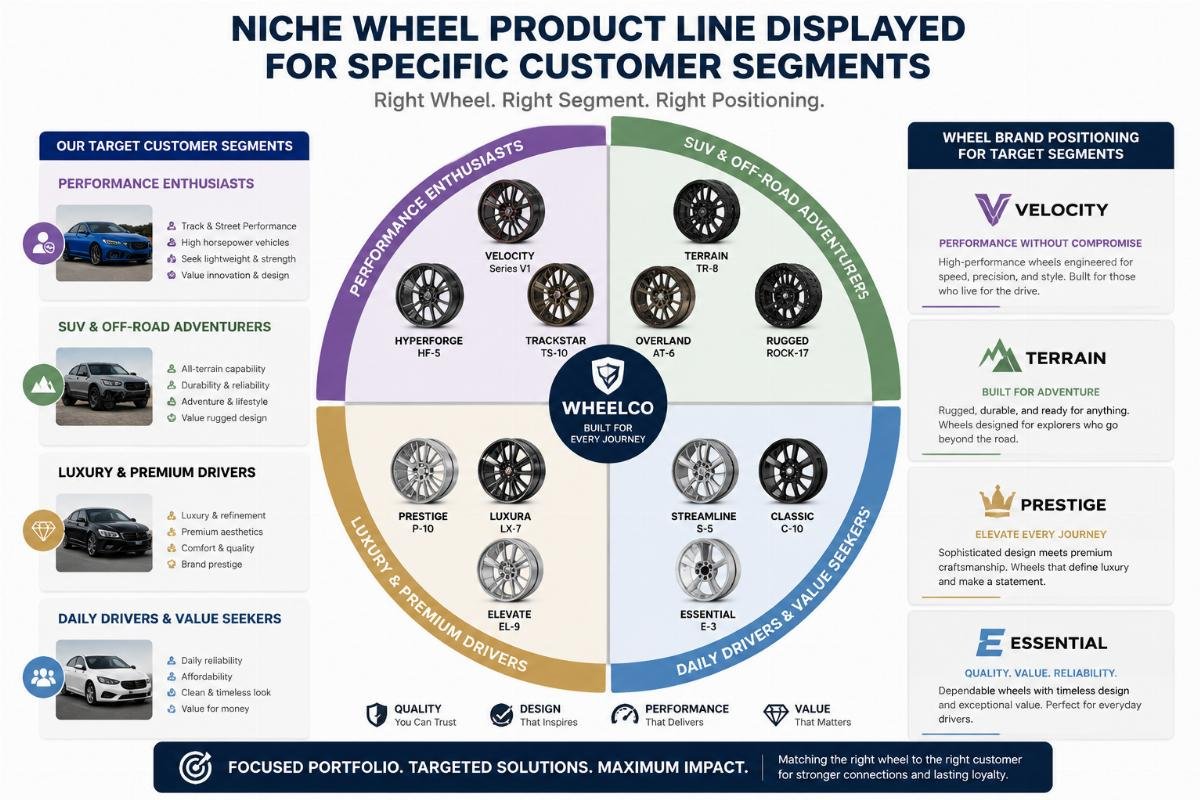
- Customer Segment Prioritization – Pick one core customer group from the five standard wheel buyer segments to focus on for your first 12 months of operation.
- Pain Point Mapping – List the top 3 unmet needs of your chosen segment, and pick a supplier that can deliver on at least two of those needs before you place your first order.
- Value Proposition Refinement – Write a one-sentence value proposition that clearly states who you serve and what problem you solve, and use that as the core of all your initial marketing content.
What inventory MOQ and mix strategy minimizes startup risk?
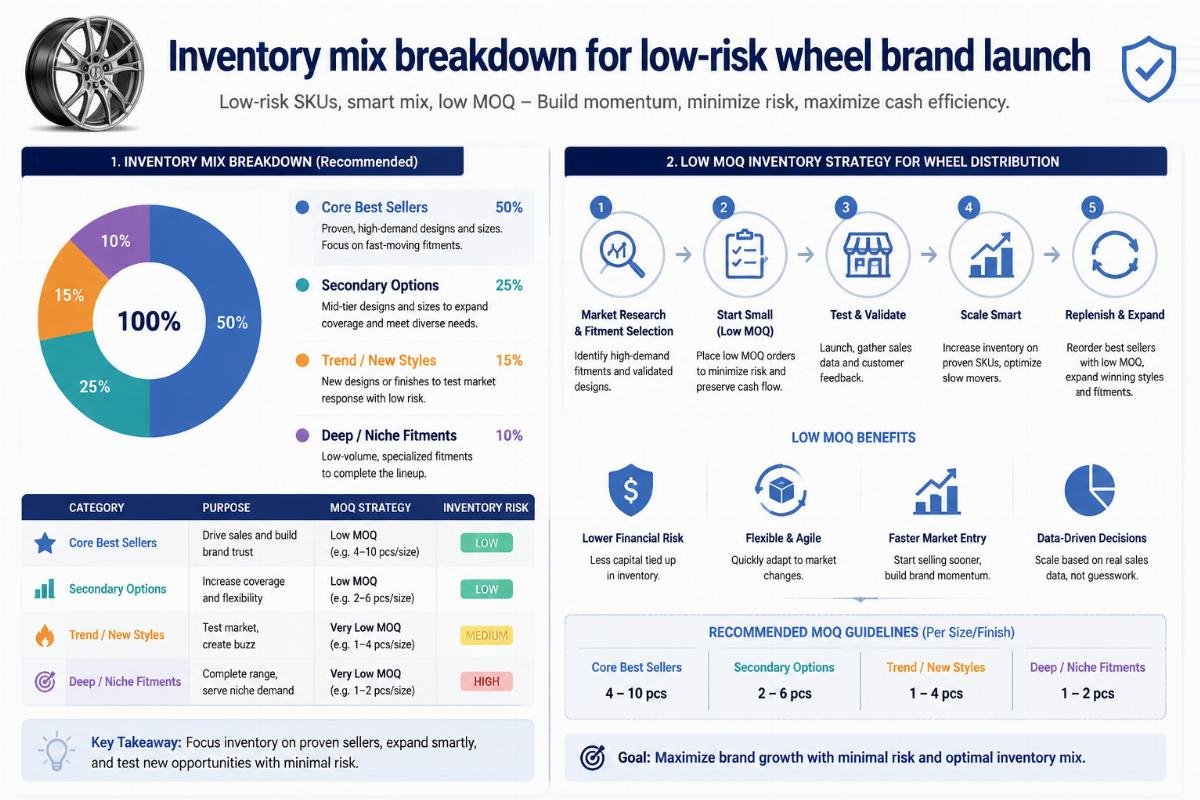
Many new distributors assume minimum order quantities above 100 units are non-negotiable for factory partnerships, but most Chinese wheel suppliers offer 20 piece MOQ for stocked models to support small test orders. This eliminates the need to lock up tens of thousands of dollars in inventory before you confirm which styles actually sell in your market.
| Inventory Factor | Common Inefficient Practice | Field-Validated Recommended Practice |
|---|---|---|
| Initial Test Order Size | Placing a full container order for 2000+ units as your first purchase | Starting with 20 piece test batches for 3-5 trending styles to validate demand before scaling [NEED_CITE: Low MOQ test order structures reduce upfront capital lockup by 40% for early-stage wheel brands] |
| Inventory Mix | Allocating 80% of inventory budget to custom experimental styles | Following a 70/30 split: 70% of inventory to proven fast-selling standard sizes, 30% to new trend-driven custom styles |
| Lead Time Planning | Waiting until inventory runs out to place restock orders | Setting automated restock triggers for top 10 SKUs when stock levels hit 30% to avoid gaps in availability for your repeat customers |
A US e-commerce seller I supported used this exact structure when they partnered on private-label wheel SKUs with Amazon-ready packaging, used 20 piece test batches for all new listings, and cut their lead time to the Amazon warehouse by 22 days compared to their previous domestic supplier.
- Test Order Validation – Place 20 piece test orders for up to 5 new styles every quarter to test emerging trends without overcommitting capital.
- Inventory Turnover Tracking – Track turnover rate for every SKU, and discontinue any style that does not sell 80% of stock within 90 days.
- Supplier Alignment – Confirm your supplier offers tiered MOQ structures that scale with your order volume before signing any long-term partnership agreement.
How to negotiate favorable partnership terms with wheel manufacturers?
Even mid-sized distributors can access exclusive territory rights, custom branding support, and factory-direct pricing when they align their order volume with supplier capacity. The key is to frame your partnership as a long-term growth opportunity rather than a one-time small order, and to prioritize suppliers that offer flexible terms for growing brands. Look for a supplier with a full multi-certification system covering VIA, TüV, and DOT standards, a wide range of wheel product lines spanning 12 to 24 inches, clear tiered MOQ rules, and a 3-year structural warranty to ensure you have a reliable foundation for scaling.

- Volume Commitment Framing – Present a 12-month projected order volume to suppliers instead of only referencing your first small test order to unlock better pricing.
- Exclusive Territory Negotiation – Ask for 12 month exclusive rights for your target region for specific SKUs, as most suppliers are willing to offer this for partners that commit to consistent quarterly orders
