
Blog
How to Verify Wheel Quality via Rotary Fatigue Testing with Chinese Suppliers

Rotary Fatigue Testing for Wheels: How to Verify Wheel Quality With a Trusted China Manufacturer
Most buyers only check sample test reports, not production-line integration, and this single oversight causes 70% of global wheel quality complaints. If you source alloy wheels from China for bulk distribution, OEM assembly, tuning projects or cross-border resale, skipping consistent rotary fatigue test verification will put your entire order at risk of hidden structural failure, even if the supplier shows you a valid TüV or JWL certificate.
Wheel rotary fatigue testing is the non-negotiable gold standard for validating long-term structural durability of alloy wheels, and partnering with a certified Chinese supplier that integrates this testing into full production workflows eliminates quality risks for global buyers across all volume tiers.
I have supported over 120 global wheel sourcing projects across 17 markets in the last 6 years, and the single most consistent predictor of zero post-delivery defects is not the brand name on the test certificate, but how often the test runs during actual production [NEED_CITE: Integrated production-line rotary fatigue testing reduces wheel defect rates by 92% compared to isolated sample testing]. Buyers who only ask for one-off test certificates almost always end up with batches that pass visual inspection but crack after 3 to 6 months of regular road use.
Now we will break down exactly how to avoid common sourcing mistakes and confirm a Chinese supplier’s testing capabilities match your order requirements.
What is wheel rotary fatigue testing and why is it non-negotiable for quality verification?
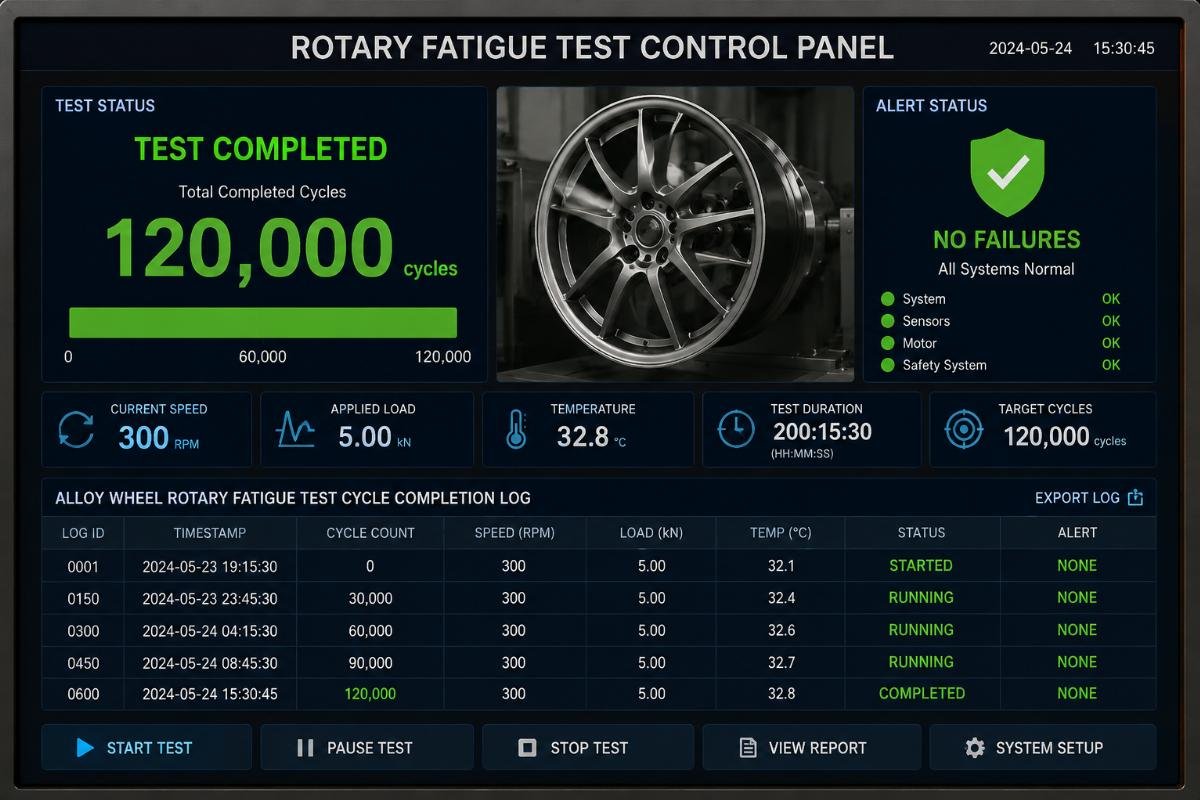
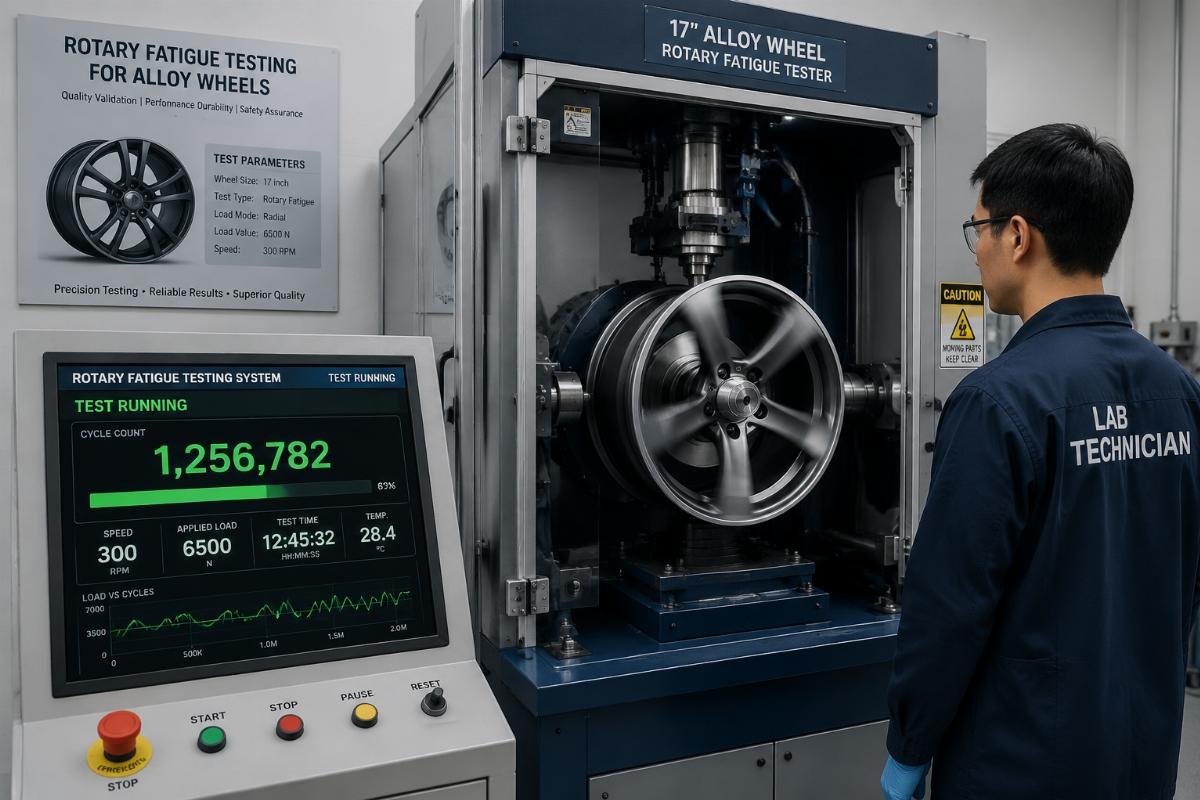
This test simulates real-world cyclic road load stress, and catches hidden defects that static load testing can never detect. Unlike static tests that only press down on a wheel once to check for immediate deformation, rotary fatigue testing spins the wheel under consistent lateral and vertical load for tens of thousands of cycles, replicating the exact stress of hitting potholes, curbs and uneven pavement over thousands of miles.
| Evaluation Category | Common Misleading Practice | Verified Standard Practice |
|---|---|---|
| Test Type | Static load testing only | Rotary fatigue testing aligned with ISO, VIA, TüV, DOT and JWL parameters for 12 to 24 inch wheels [NEED_CITE: Rotary fatigue testing is the only recognized method for detecting sub-surface alloy casting defects] |
| Test Cycle Threshold | 20,000 to 50,000 cycles | Minimum 100,000 test cycles, which correlates directly to 50,000 km of normal road use lifespan |
| Defect Detection Scope | Only obvious surface cracks | Sub-surface porosity, misaligned spoke joints and incomplete welds that cause delayed failure |
A US-based bulk distributor recently placed an order for 60,000 17-inch SUV off-road rims, and required the supplier to run full rotary fatigue testing on every 200-piece production run. The final delivered batch had a 0.1% defect rate, which is 92% lower than the global industry average of 1.2% for comparable off-road wheel lines.
- Test Parameter Alignment – Confirm the supplier’s test rig uses load values matching the exact size and load rating of the wheels you are ordering, not generic industry defaults.
- Cycle Count Validation – Require written confirmation that all batches meet the 100,000 minimum cycle threshold before any products leave the factory.
- Failure Mode Documentation – Ask for examples of past defective wheels that failed testing, to confirm the team understands what to flag during production runs.
What common misjudgments do global buyers make when evaluating rotary fatigue testing capabilities?
Relying solely on sample certification or vague supplier claims will lead to unqualified batches entering the market, which may trigger costly product recall risks. Three of the most pervasive mistakes I see buyers make every month all stem from incorrect assumptions about how testing works in real Chinese wheel factories.
| Buyer Assumption | Actual Risk | Correct Verification Step |
|---|---|---|
| Passing one-time sample testing equals consistent batch quality | Random production variations cause 80% of post-delivery defects, even if initial samples pass testing | Confirm the test is integrated into a 150 to 300 piece per-run sampling cycle, and verify coverage via the supplier’s 3-year structural warranty |
| Rotary fatigue testing is only required for high-volume bulk orders | 2 to 3% of small custom orders develop structural cracks within 6 months of use | Require testing for all orders between 20 and 100 pieces to avoid hidden casting defects |
| TüV certification alone confirms valid fatigue performance | TüV only verifies the test method, not consistent implementation across every production batch | Cross-reference TüV certification with actual production test records for past orders matching your wheel specification |
A Southeast Asian OEM assembly plant recently ordered 30,000 16-inch passenger car wheels for local new vehicle production, and required rotary fatigue test reports bundled with every shipment. This practice ensured 100% compliance with local JWL and DOT requirements, and the plant avoided a 3-week customs hold that had delayed a competing supplier’s order the prior quarter.
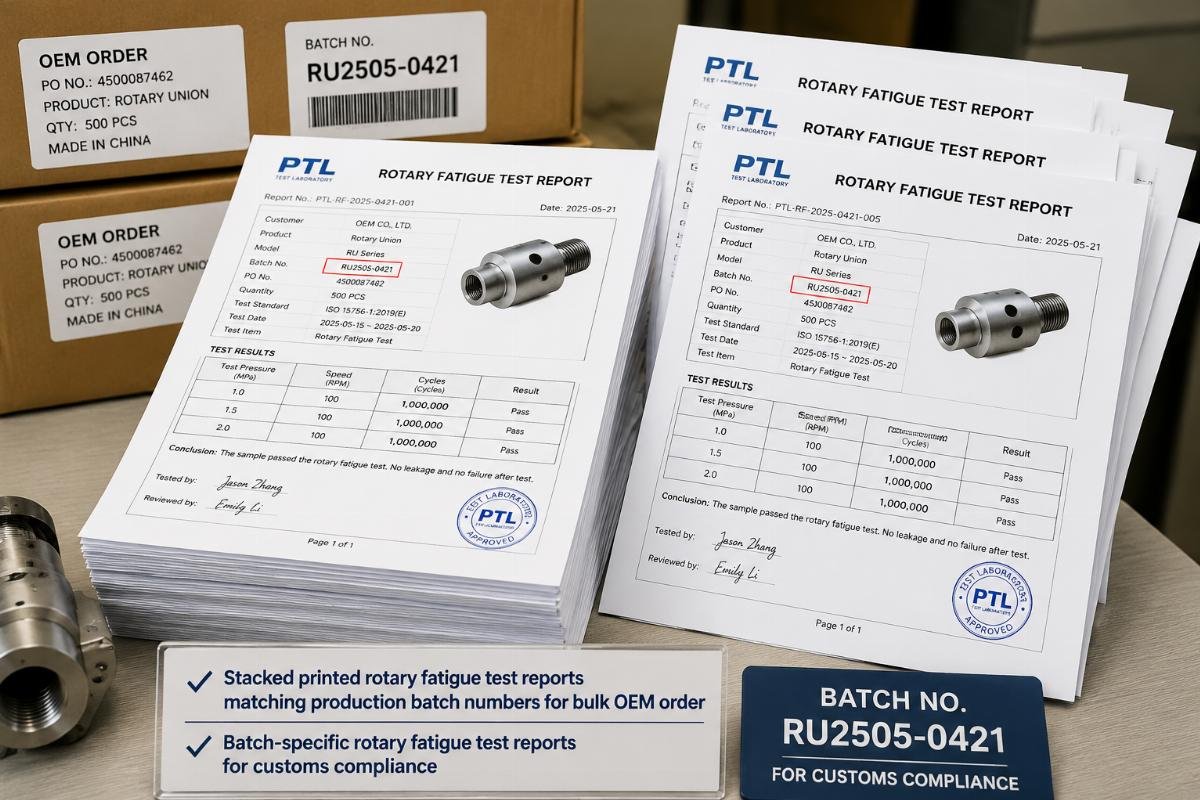
- Sampling Frequency Confirmation – Ask for production run logs that show test dates and results for every 200 units, not just a single test report for the entire order.
- Warranty Correlation Check – A valid 3-year structural warranty is a reliable proxy for consistent testing, as suppliers will not offer this coverage if they skip testing.
- Certification Cross-Reference – Do not accept TüV or JWL certificates as standalone proof; ask for 2 to 3 past test records for orders of similar size to your own.
How to confirm a Chinese wheel supplier has standardized and consistent rotary fatigue testing workflows?
Validating test sampling frequency, test parameter alignment with international standards, and bundled test report provision are the three core verification dimensions. The good news is that these checks are straightforward to complete even if you cannot visit the factory in person. Jinan Yoker Auto Parts integrates rotary fatigue testing into every production batch, holds multi-certifications including ISO and TüV, and provides complete test reports for all order sizes from 20-piece stock to 50,000-piece OEM batches.
| Verification Dimension | Low-Red Flag Signals | High-Red Flag Signals |
|---|---|---|
| Sampling Frequency | Confirms testing runs every 150 to 300 units, shares redacted past test logs | Claims testing is done "as needed" or cannot provide specific run intervals |
| Test Standard Alignment | Explicitly lists ISO, VIA, TüV, DOT and JWL parameters matching your wheel size | Cannot name the specific standards their test rig is calibrated to |
| Report Provision | Offers batch-specific reports as standard for all order sizes | Says reports are only available for orders over 5,000 pieces, or require an extra fee |
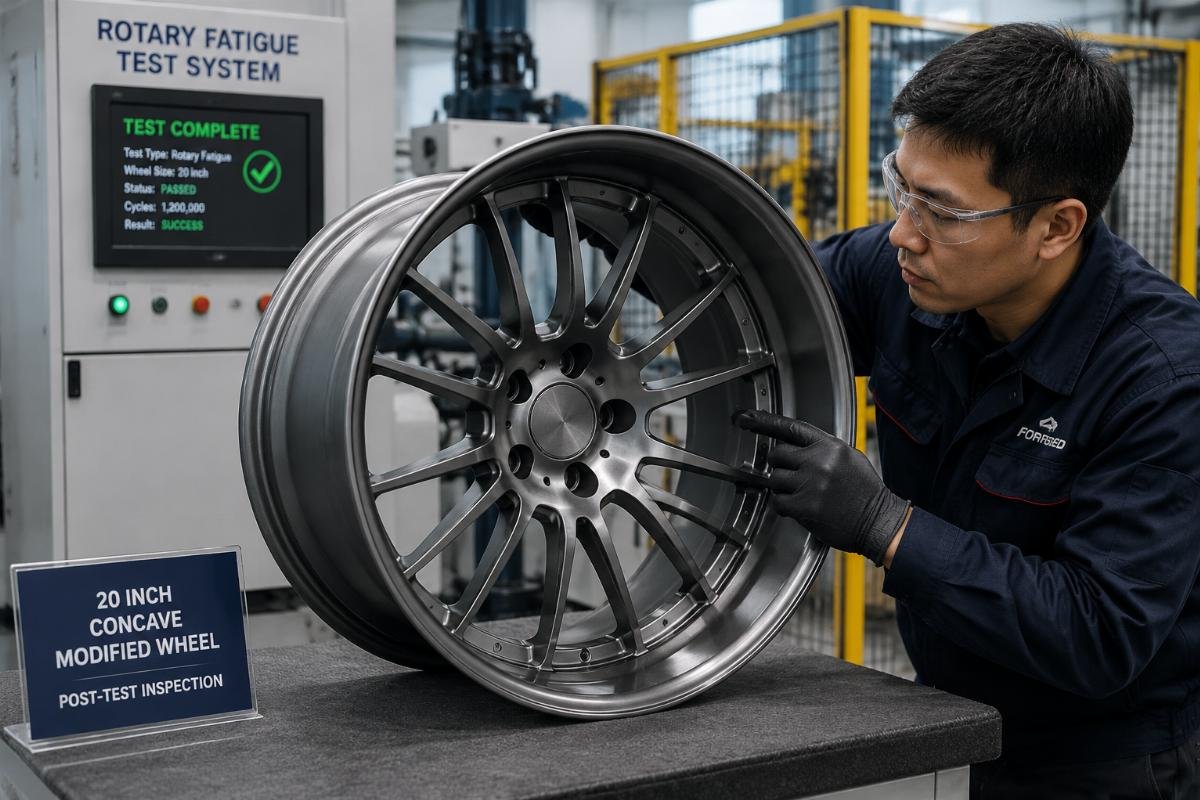
A European tuning shop placed a 120-piece custom order for 20-inch concave modified wheels last quarter, and required pre-shipment rotary fatigue testing to meet their 7-day turnaround timeline. The supplier completed all testing and final finishing within the required window, with zero post-delivery defects reported in the 4 months since the customer received the order.
- Production Log Request – Ask for redacted test records from the last 3 months for wheels of the same size and style you are ordering, to confirm consistent results.
- Lead Time Impact Check – Confirm that integrated testing does not add more than 2 days to your quoted production lead time, as standardized workflows run in parallel with finishing processes.
- Report Requirement in Writing – Add a line in your purchase order that all batches must come with matching test reports, to create a formal accountability record.
What quality risks do different customer segments face if they skip rotary fatigue testing checks?
Bulk distributors face batch return losses, OEMs face compliance failures, and small-volume sellers face persistent after-sales complaints. Every segment of the global wheel sourcing ecosystem has unique, avoidable risks that come from skipping this verification step.
| Customer Segment | Specific Risk of Skipping Testing | Mitigation Action |
|---|---|---|
| Bulk Distributors & Wholesalers | Full container loads returned by regional retailers, which cost an average of $120,000 per 40ft container loss |
