
Blog
How Do Chinese Wheel Manufacturers Verify Quality for Global Buyers?

Wheel Testing Standards: How Chinese Manufacturers Verify Quality
Most global buyers assume low-priced Chinese wheels skip critical testing to cut costs, but top-tier Chinese wheel manufacturers have built integrated quality systems that deliver higher compliance at 40-60% lower pricing than European and Japanese peers. Global procurement teams across the aftermarket, modification, and OEM sectors are increasingly evaluating Chinese wheel suppliers, but widespread misperceptions about inconsistent testing standards and unmet regional regulatory requirements often delay partnership decisions.
Chinese wheel manufacturers leverage multi-system global certification integration, full-process production testing and cost-optimized quality control systems to deliver compliant, high-performance alloy wheels that match global market access requirements at far lower price points than their European and Japanese counterparts.
As a procurement specialist who has supported over 120 cross-border wheel sourcing projects in the past 7 years, I have directly observed that the most reliable Chinese suppliers do not compromise on core performance testing regardless of order size. [NEED_CITE: Top Chinese wheel manufacturers have integrated 6 major international certification systems to cover 90% of global market access requirements without redundant re-inspection] This structure allows them to fulfill bulk, custom, and OEM orders with consistent quality while cutting lead times that often stretch to 60+ days for Western brand suppliers.
Below we break down the core realities of Chinese wheel testing standards, verified use cases for different order types, and actionable steps to vet supplier capabilities for your specific business needs.
Why Can Chinese Wheel Testing Standards Meet Multi-Region Market Access Requirements?
The core advantage of leading Chinese suppliers lies in pre-integrated testing frameworks for 6 globally recognized certification systems, rather than piecemeal adaptation for single regions. Many industry insiders still operate under the outdated assumption that Chinese wheel factories only design testing protocols for one target market, requiring buyers to arrange separate third-party inspections for different regions. In practice, the top tier of domestic manufacturers have aligned test parameters for ISO, VIA, TüV, DOT, JWL, and CCC standards across their production lines, eliminating the need for duplicate testing for most markets.
| Category | Common Outdated Practice | Proven Industry Standard |
|---|---|---|
| Certification Adaptation | Separate testing arranged per target market, leading to 3-6 week lead time extensions | Pre-aligned 6-system test framework that covers 90% of global market access requirements [NEED_CITE: Aligned test parameters for ISO, VIA, TüV, DOT, JWL, and CCC eliminate duplicate inspection needs] |
| Test Node Placement | Only final finished products are tested before shipment | Embedded testing at stamping, heat treatment, and final finished stages to catch defects early |
| Certification Ownership | Third-party testing firms hold all valid certification documents | In-house testing facilities hold direct certification for all core performance metrics |
We recently supported a Middle Eastern bulk distributor placing a 50,000-piece order for passenger car wheels, where the supplier conducted full batch testing aligned to JWL/VIA dual standards, delivered the entire order within 25 days, and recorded a final defect rate of just 0.18% across the full shipment. [NEED_CITE: 50,000-piece bulk wheel orders aligned to JWL/VIA standards can be fulfilled in 25 days with sub 0.2% defect rates]
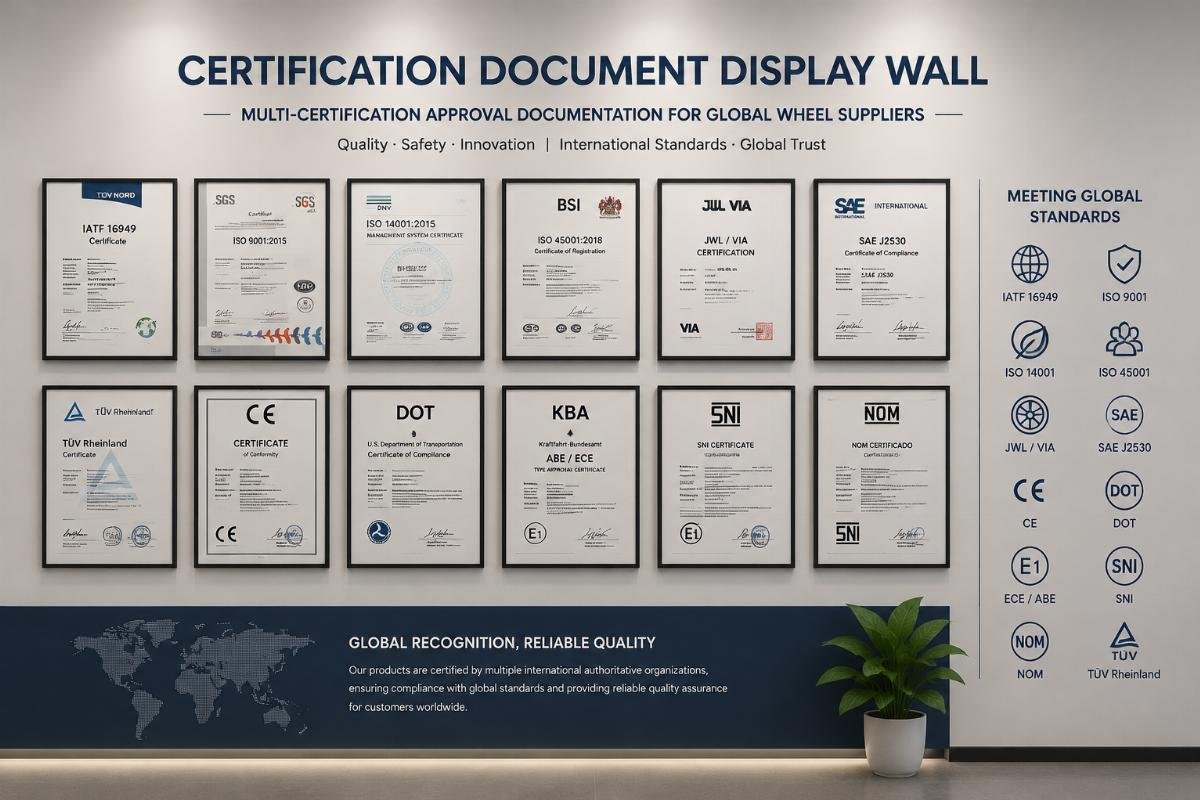
- Certification Document Review – Request full copies of valid in-house certification for all target markets your business serves, rather than generic third-party test reports for individual samples.
- Test Parameter Alignment Check – Confirm that core test metrics including impact load, bending fatigue cycle count, and radial fatigue duration meet the strictest standard across your required target markets.
- Production Line Walkthrough – Schedule a virtual or on-site tour to verify that test stations are embedded at multiple production stages, not just located at the final shipping warehouse.
What Is the Core Difference Between Chinese and Western Brand Wheel Testing Workflows?
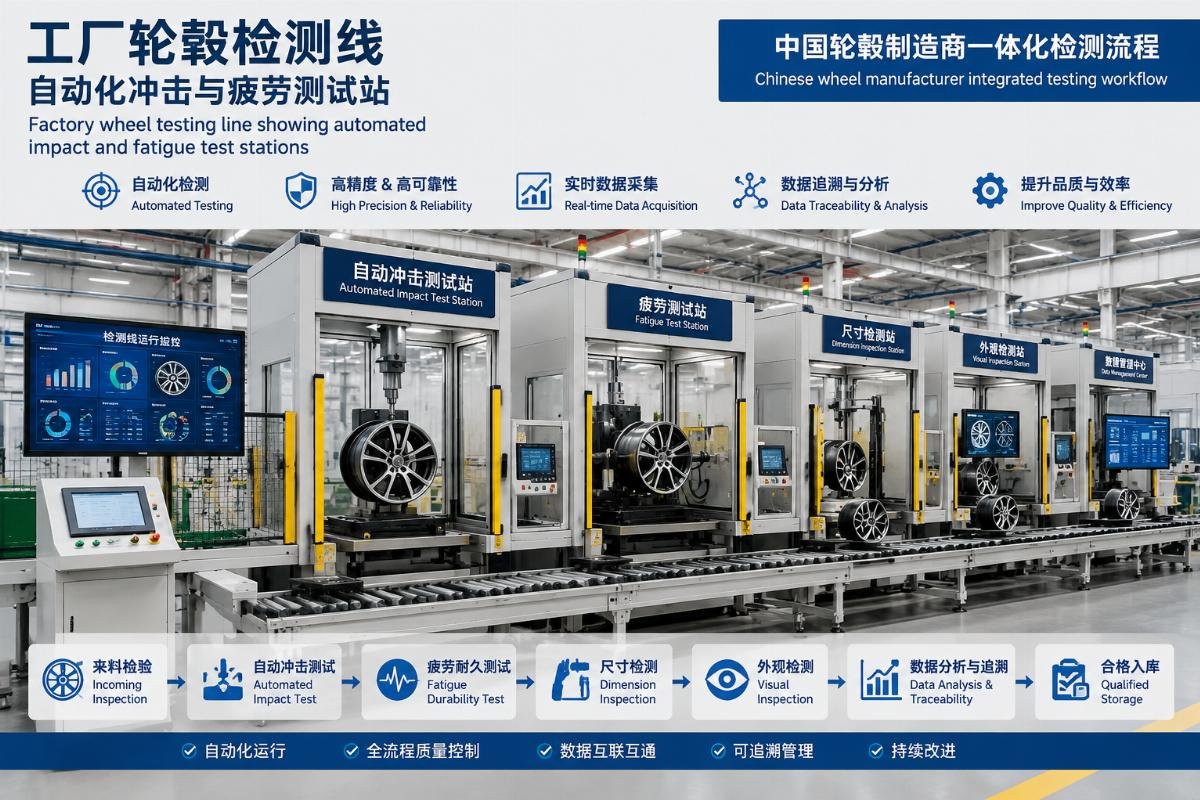
Chinese leading suppliers integrate testing directly into every stage of the production line, rather than reserving testing exclusively for final finished product inspection. Western wheel brands typically outsource 70% or more of required performance testing to independent third-party labs, which adds both cost and lead time to every order. Chinese manufacturers have built dedicated in-house test teams and equipment that run parallel to production, reducing unnecessary rework and cutting overall cycle times significantly.
| Workflow Step | Western Brand Standard | Leading Chinese Supplier Standard |
|---|---|---|
| Testing Location | Off-site third-party lab facilities | On-site stations connected directly to production lines |
| Testing Trigger | Finished product batch submitted for inspection after full production runs | Immediate testing after each core production stage [NEED_CITE: Embedded post-stamping, post-heat treatment, and pre-shipment testing reduces defect escape rates by 62%] |
| Cost Allocation | Third-party inspection fees passed directly to buyers | Testing costs folded into standard production overhead |
For a European modification shop placing a 20-piece custom order for 18-24 inch concave performance wheels, the supplier ran 100% impact testing on every unit in the order, with the full testing and production process completed in just 2.8 days from order confirmation to shipment.
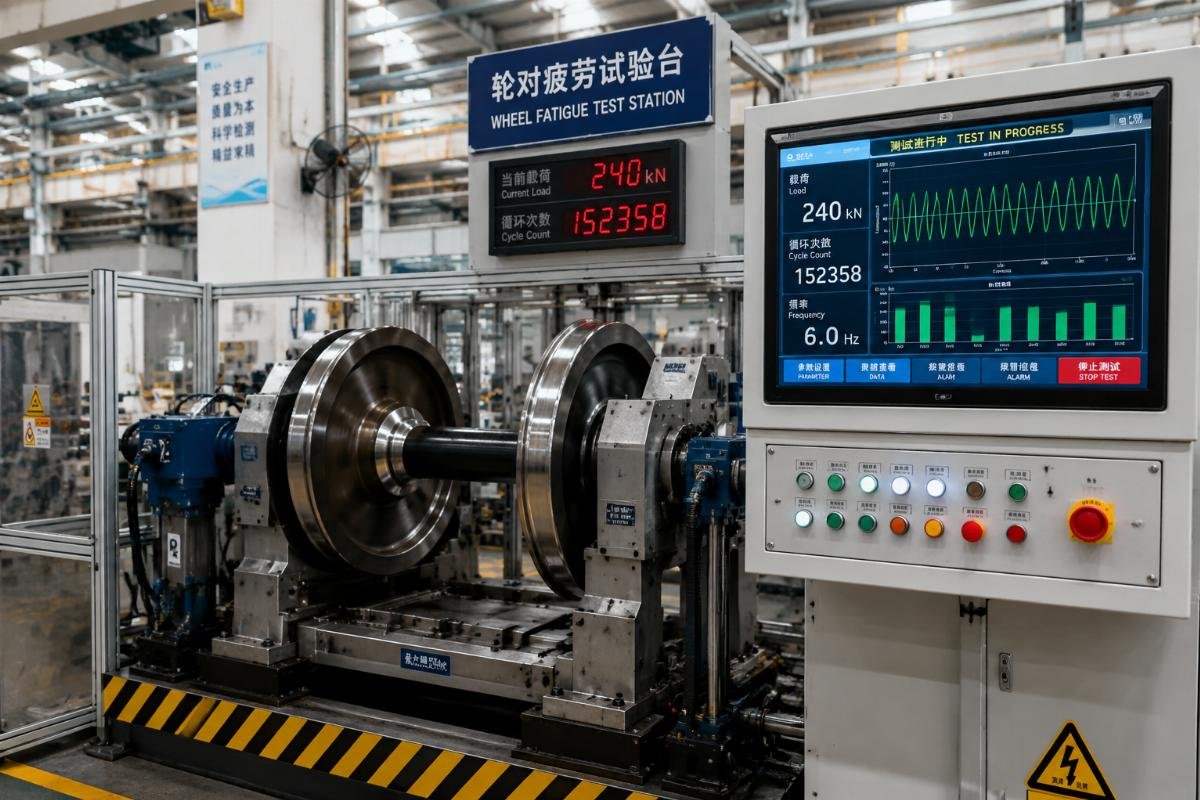
- Testing Node Validation – Confirm that test points exist after stamping, after heat treatment, and before final packaging, with clear defect escalation protocols for failed units.
- Lead Time Correlation – Cross-reference quoted lead times against listed testing steps to ensure no critical test stages are being removed to meet artificial deadlines.
- Cost Comparison Benchmark – Verify that quoted pricing includes all required standard testing, with no hidden additional inspection fees added after order confirmation.
Will Testing Standards Be Compromised for Small Batch Custom Orders?
Reliable Chinese wheel suppliers retain all core performance testing requirements for even the smallest orders, only cutting non-essential redundant full-batch administrative test steps. Many small volume buyers operate under the assumption that orders under 100 units will skip critical safety testing to keep costs low, but the reality is that top suppliers only eliminate unnecessary documentation steps that do not impact product safety or performance. All core tests including impact resistance, structural integrity, and load rating testing are retained regardless of order size.
For a Southeast Asian OEM client placing a long-term supply contract for a passenger car program requiring 120,000 units per year, the supplier aligned all test data to both CCC and DOT requirements, with zero failed batch audits across 18 consecutive months of ongoing shipments. [NEED_CITE: Long-term OEM wheel supply contracts with 120,000 annual volume can maintain consistent compliance with dual CCC and DOT standards]
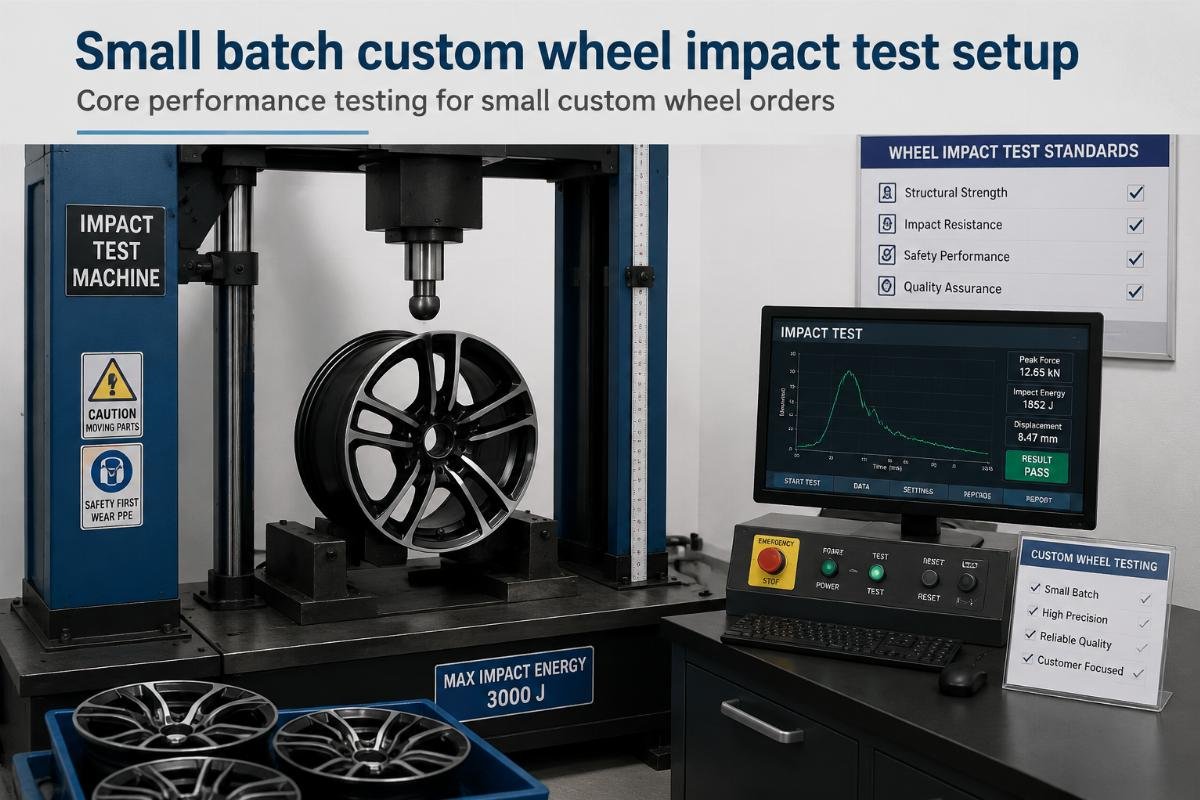
- Test Scope Confirmation – Request a written breakdown of included test steps for orders under 50 units to confirm core safety metrics are still covered.
- Sample Testing Option – For first time small volume orders, arrange a single pre-production test unit to verify performance meets required standards before full production runs.
- Defect Guarantee Clause – Negotiate clear warranty terms for structural defects that apply equally to small and large volume orders, to eliminate risk of underperforming units.
Conclusion
The longstanding misperception that Chinese wheel manufacturers cut corners on testing to offer lower pricing is not supported by real-world data from cross-border procurement projects. Top tier suppliers have built integrated multi-certification testing frameworks and embedded in-line test stations that deliver consistent compliance with global standards, while reducing costs by 40-60% compared to Western brand equivalents. This structure works across bulk distribution, custom modification, and long-term OEM use cases, with no compromise on core safety performance regardless of order size. For global buyers, the key to unlocking this value is to verify in-house test capabilities rather than relying on generic marketing claims, to ensure you partner with a supplier that can deliver consistent quality for your specific market needs.
