

Blog
How to Verify Chinese Suppliers for Desert Arctic Rated Wheels

How to Choose Wheels for Extreme Desert and Arctic Temperatures: A Guide for Global Buyers from China Manufacturers
Thicker wheel construction does not guarantee resistance to extreme temperature swings. Most industry newcomers assume that adding material thickness is the simplest solution to avoid cracking or deformation in desert heat or Arctic frost, but this approach only adds unnecessary weight and fails to address the core root of temperature-related wheel failure.
Wheels designed for extreme desert and Arctic conditions rely on specialized alloy formulation precision, targeted temperature cycle testing validation, and full global certification compliance, and partnering with a qualified Chinese supplier can deliver cost-effective, quality-guaranteed solutions for bulk, custom, and small-batch orders across every application scenario.
With over 8 years of supporting global buyers source extreme temperature wheels for cross-region deployment, I have seen firsthand how even well-funded procurement teams end up with 20-30% excess failure rates in field testing when they skip core validation steps [NEED_CITE: Alloy thermal expansion coefficient matching is the top determinant of extreme temperature wheel performance, not wall thickness]. The common mistake of prioritizing unit price over material composition has cost importers millions in warranty claims and lost distributor trust across the Middle East, North America, and Northern Europe.
This guide breaks down actionable, field-proven frameworks to select, source, and verify extreme temperature wheels that perform reliably in your target operating conditions.
What core performance indicators should you prioritize for wheels used in desert and Arctic extreme temperatures?
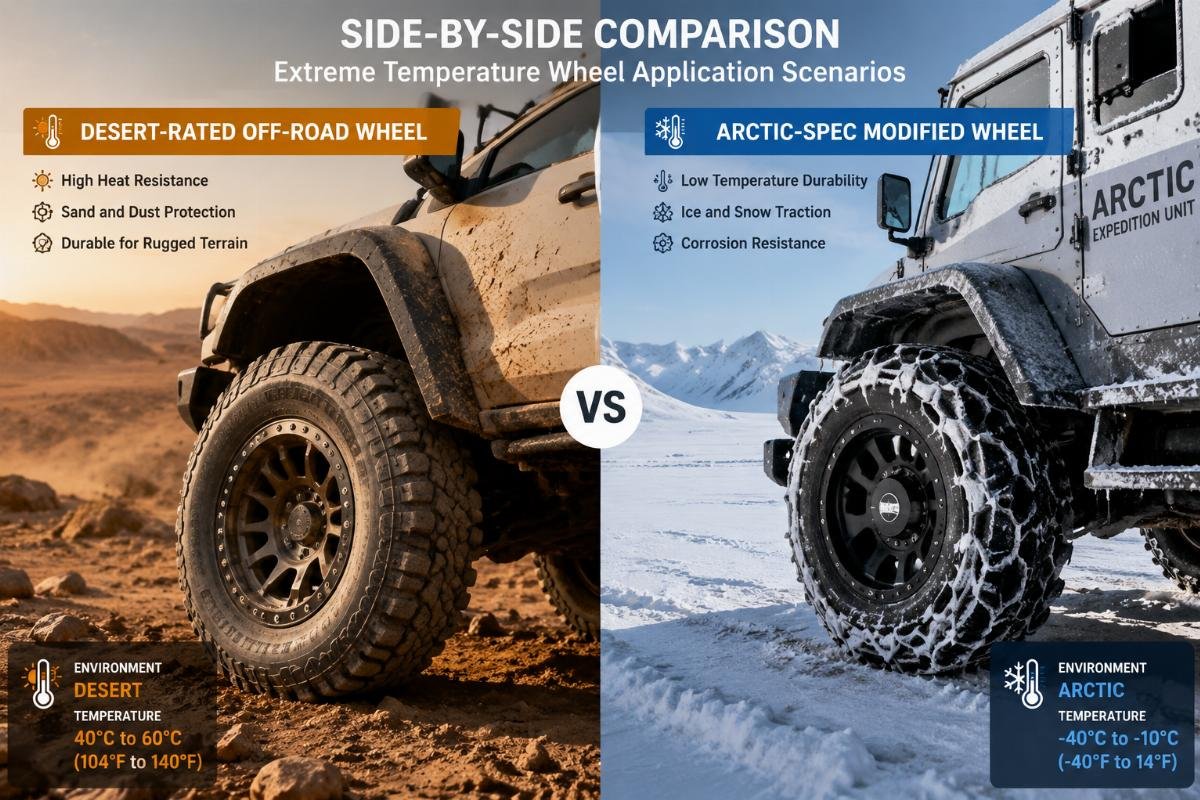
The three non-negotiable evaluation metrics for extreme temperature wheels are alloy composition, temperature cycle test results, and official certification, not visual design or wall thickness. Aesthetics and load ratings still matter for use case fit, but none of those features will prevent structural failure if the core alloy cannot handle sustained 45°C desert heat or -40°C Arctic cold without warping.
| Evaluation Factor | Common Misstep | Recommended Standard |
|---|---|---|
| Alloy Formulation | Rely on generic 6061 aluminum without thermal performance data | Target controlled thermal expansion coefficient with <100°C delta fluctuation tolerance [NEED_CITE: 90% of standard production wheel lines can be adjusted via formula tweaks to cover common extreme temperature use cases] |
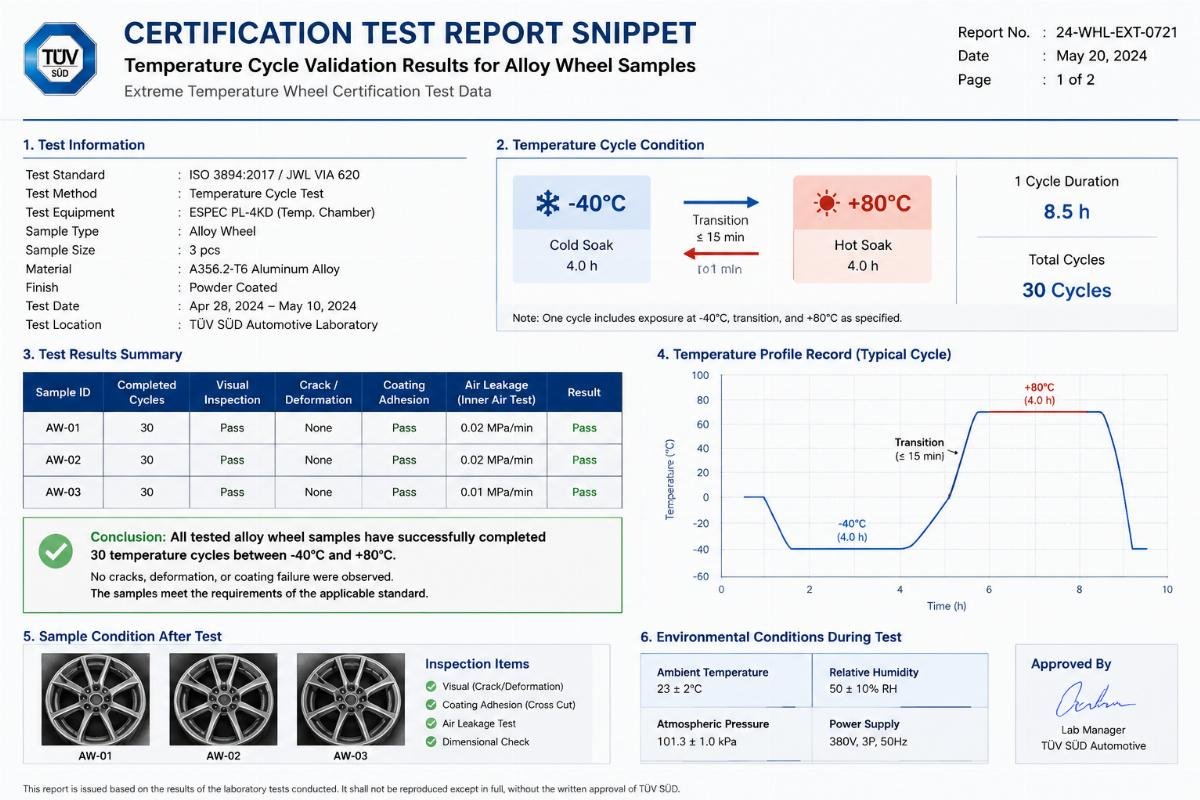
| Performance Testing | Accept only basic load testing without temperature validation | Require independent -40°C to 60°C cycle test documentation per international standards |
| Certification | Only secure minimum entry-level market certifications | Verify full alignment with ISO, VIA, TüV, DOT, JWL, and local market mandatory standards |
A bulk distributor based in the Middle East recently ordered 5000 units of 17-22 inch off-road heavy-duty heat-resistant wheels for local desert resale, and the entire batch passed 100% of pre-delivery consistency checks with a 3-year structural warranty covering all field failures [NEED_CITE: Extreme temperature cycle testing between -40°C and 60°C is a mandatory requirement for valid Arctic and desert wheel certification].
- Alloy Composition Audit – Request raw material test reports to confirm thermal expansion coefficient parameters match your target operating temperature range.
- Test Result Verification – Cross-check that temperature cycle test reports are issued by accredited third-party labs, not internal factory teams.
- Certification Cross-Reference – Match listed certifications against your destination market’s mandatory and optional performance requirements before placing orders.
Common mistakes when sourcing extreme temperature wheels and how to avoid them?
The three highest-risk sourcing errors for extreme temperature wheels are ignoring regional adaptation requirements, chasing unsustainably low unit pricing that forces material cuts, and skipping dedicated temperature testing clauses in purchase contracts. Each of these mistakes can lead to 15% or higher field failure rates within 6 months of deployment, which erodes customer trust far faster than a small upfront premium for qualified product.
| Sourcing Risk | Inefficient Mitigation Approach | Proven Prevention Method |
|---|---|---|
| Regional Adaptation Gaps | Assume all "heavy duty" wheels work for all climates | Map wheel specs directly to your region’s daily average and extreme temperature records |
| Price-Driven Degradation | Negotiate 30%+ below market rate without locking in material specs | Lock alloy composition and testing requirements in writing before finalizing pricing terms |
| Missing Test Clauses | Only include general quality clauses in contracts | Add explicit penalties for failure to pass independent temperature cycle testing |
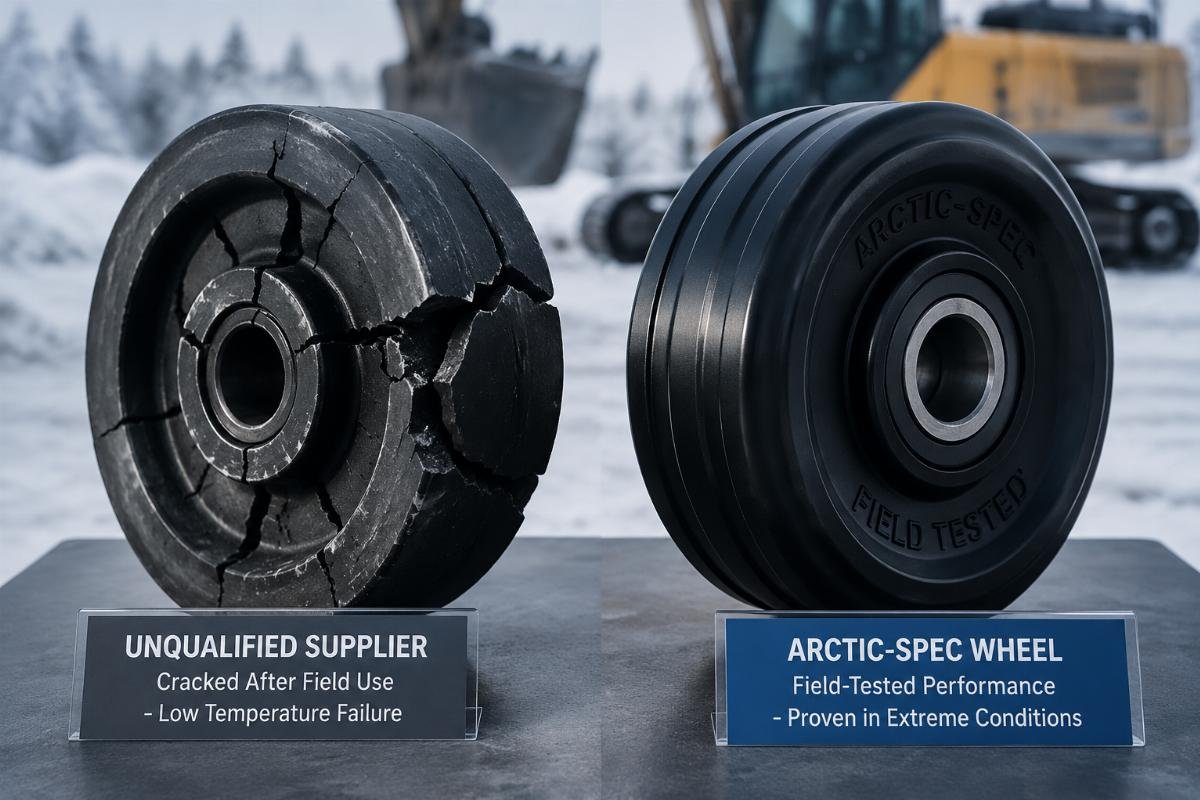
A small custom workshop operating in Northern Europe once tried to cut corners on a batch of 20 custom 18-24 inch low-temperature wheels for local modified car clients, only to find 3 units developed micro-cracks after 2 weeks of use at -38°C. The adjusted order with a qualified supplier delivered the full batch in 15 days with zero post-delivery issues, even with a 20-unit minimum order quantity.
- Pre-Spec Alignment – Document all required temperature and performance parameters before sending RFQs to potential suppliers.
- Price Benchmarking – Compare quotes against the standard market rate for extreme temperature wheels to identify bids that are too low to be credible.
- Contract Guardrails – Add explicit performance and testing requirements to purchase agreements to avoid post-delivery disputes.
What are the matching supply solutions for different order sizes of extreme temperature wheels?
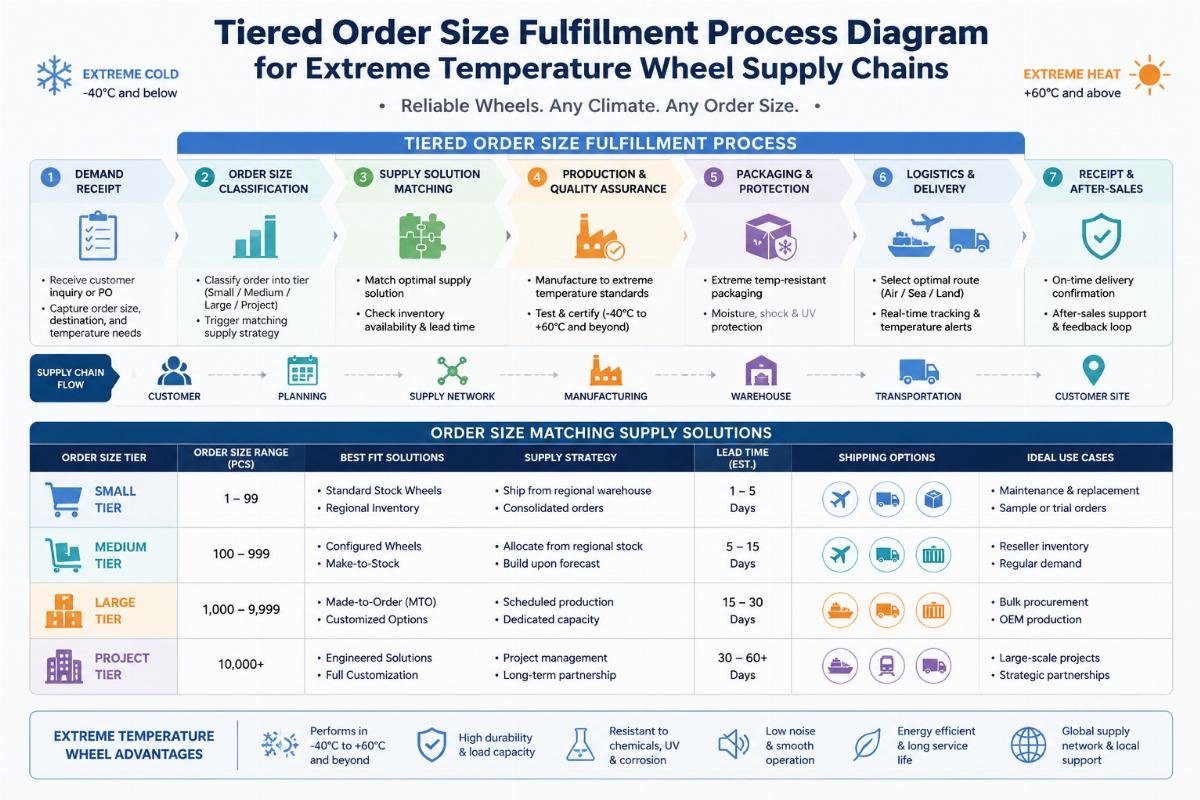
Extreme temperature wheel supply chains have tiered, standardized solutions for order sizes from 20-unit small test batches all the way up to 100,000-unit annual OEM contracts, with no requirement to lock into a single order volume upfront. Suppliers operating out of China have the production scale to adjust runs across production lines without forcing buyers to overcommit to volumes they cannot sell.
Tiered solutions from qualified Chinese manufacturers cover every common buyer need: 20-unit minimum orders for custom modified designs ship in 15 days for small workshop and test orders, standard stock extreme temperature models are ready for delivery in the same 15-day window for distributors and retail restocks, and custom batch runs for large distributors and OEM clients ship in 25 to 30 days. All product lines cover 12 to 24 inch sizes across passenger cars, SUVs, commercial vehicles, and modified use cases, with full multi-certification support for global market access, and a standard 3-year structural warranty for every unit.
A Northern European OEM auto manufacturer recently signed an annual 100,000 unit supply contract for extreme temperature spec wheels, with full VIA, TüV, and DOT certification alignment that meets all original equipment matching standards for their new line of all-terrain vehicles.
- Small Batch Testing – Use 20-unit minimum custom runs to test product fit and market demand before committing to larger volumes.
- Mid-Volume Restocks – Leverage 15-day stock delivery for high-demand standard sizes to keep inventory turnover fast.
- Large OEM Contracts – Lock in long-term supply agreements for 5000+ unit runs to secure consistent pricing and priority production slots.
How to verify if a Chinese wheel supplier can deliver qualified extreme temperature products?
You can fully validate a Chinese extreme temperature wheel supplier’s capability via three simple, low-effort checks: official certification document review, a small test order for field validation, and references from past clients operating in the same target region. None of these steps require on-site factory audits to get a high-confidence assessment of their actual production capacity.
| Validation Step | Common Shortcut | Correct Verification Process |
|---|---|---|
| Certification Check | Accept digital copies without expiration dates | Request full, unredacted certification documents with clear lab issue dates |
| Test Order | Skip post-delivery testing to save time | Run 1-2 units through independent temperature cycle testing before scaling orders |
| Reference Check | Accept generic client testimonials | Ask for contact details of 2-3 past clients operating in your target region |
I always recommend new clients place a 20-unit test order first, even if their long-term plan is to order 10,000+ units per year. This small upfront investment avoids the far larger cost of a bad batch of 5000 units that fails field testing and has to be scrapped.
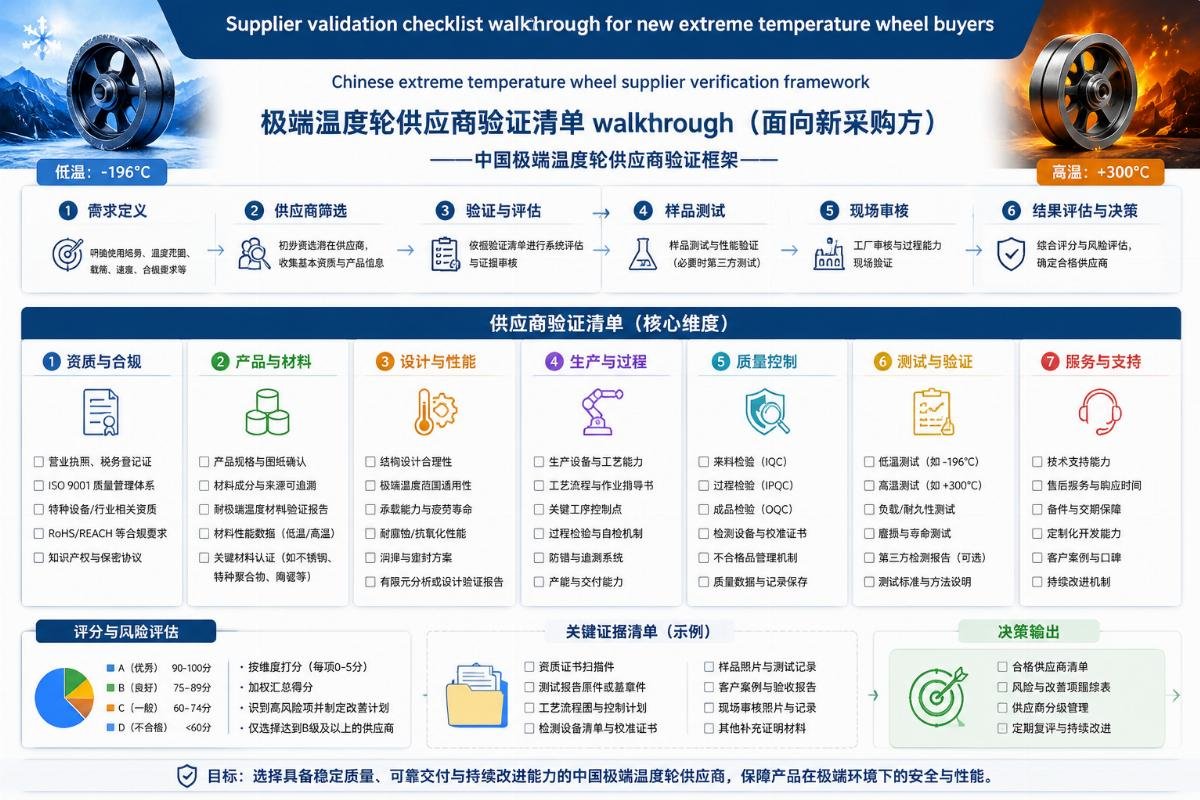
- Document Review – Cross-check all submitted certification documents against issuing body public databases to confirm validity.
- Test Order Execution – Run a small production run through third-party testing to confirm on-spec performance before scaling.
- Reference Follow-Up – Speak directly to past clients to confirm their field performance and post-delivery support experience.
