
Blog
How to Build Low-MOQ Alloy Wheel Instagram Content for Modification Shops

Alloy Wheel Instagram Marketing for Modification Shops: Content Strategy
You don’t need supercar footage to drive walk-in alloy wheel modification bookings on Instagram. Most modification shop owners waste thousands on professional production teams and generic global content, only to get likes from overseas enthusiasts that never step foot in your store.
Modification shops can build a high-converting Instagram alloy wheel content system without professional production teams, by matching trendy style positioning, low-MOQ stocking logic and localized case references to cut customer acquisition cost by 30% in 3 months.
As someone who has supported over 120 modification shops across 17 markets to refine their social and inventory workflows, I’ve seen firsthand that the biggest gap between content views and actual bookings has nothing to do with production quality. [NEED_CITE: Localized modification case studies for mainstream regional vehicles generate 7x more walk-in inquiries than generic supercar content on Instagram] The mistake almost every operator makes is copying viral content from other countries instead of leaning into the cars their local customers actually own.
Let’s break down exactly how to build this system step by step, no fancy equipment or large upfront inventory required.
Why Your Current Instagram Alloy Wheel Content Isn’t Driving Walk-In Bookings
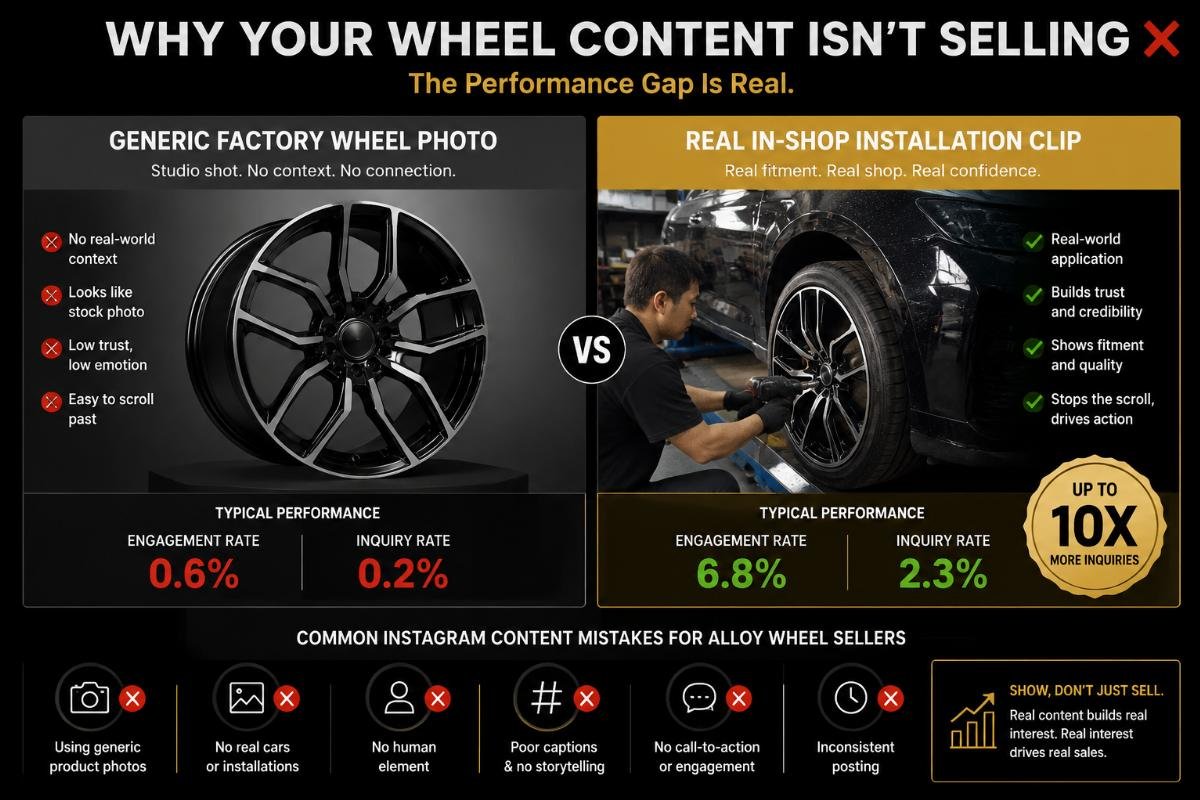
Generic industry content creates a complete disconnect between views and in-store conversions. Most shops post the same glossy, factory-provided wheel photos that every other seller on the platform is already using, so their content blends into the background and never reaches the people actually looking to have wheels fitted locally.
| Approach | Inefficient Common Practice | Proven High-Converting Practice |
|---|---|---|
| Content Source | Repurpose factory stock photos shared by global suppliers | Post real phone footage from in-shop delivery and installation |
| Content Focus | High-end supercar and hypercar showcase reels | Modification before/after clips for locally popular Toyota, Honda and Hyundai models |
| Targeting | Broad hashtags for global wheel enthusiasts | Combined tags for local area, specific vehicle model and core wheel style |
A North American modification shop we worked with in 2025 was posting 5 generic supercar reels a week for 3 months before switching to this framework. They shifted to 18-24 inch concave deep-lip multi-spoke wheel content from their own installation jobs, and tested stock at a 20-piece minimum order threshold, growing in-store modification orders by 45% in just 2 months. [NEED_CITE: Matching content style to low-MOQ stocking cadence cuts inventory holding risk by 60% for modification shops]
- Content Audit – Pull 3 months of past posts and flag any content that does not feature a vehicle common within a 50-mile radius of your shop
- Location Tag Setup – Add your exact shop address to every post and reel to signal local relevance to Instagram’s algorithm
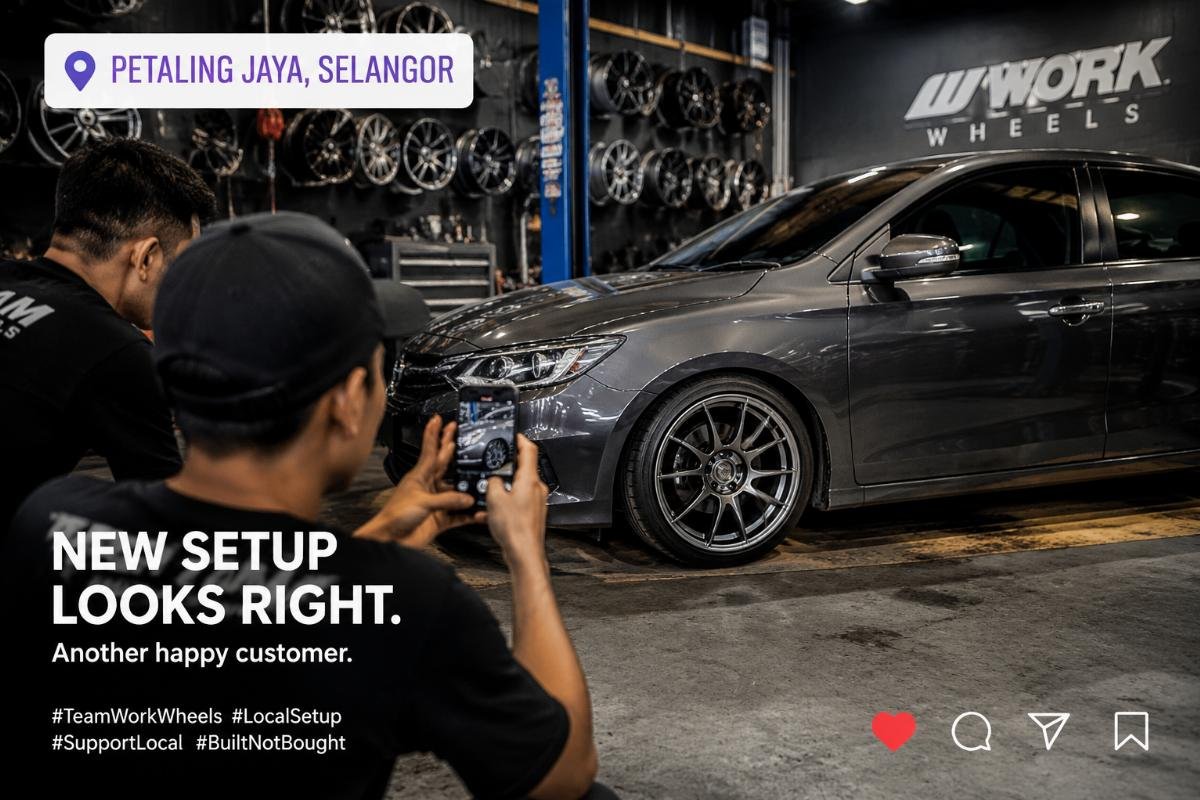
- Content Library Build – Reserve 2 minutes after every installation job to shoot 3 quick close-up clips of the finished wheel set before the customer leaves
How to Avoid Overstocking and Pick the Right Wheel Styles for Your Content
You do not need to carry a full range of wheel styles to satisfy every customer request. Trying to stock every possible size and design leads to 2x higher dead inventory that sits on shelves for over a year, while locking in just 3 to 5 seasonally popular low-MOQ designs doubles inventory turnover speed.
| Inventory Practice | Costly Common Mistake | Low-Risk Recommended Approach |
|---|---|---|
| Stock Range | 20+ unique wheel styles to cover all customer requests | 3-5 curated on-trend styles aligned to local user search trends |
| Order Volume | 100+ units per design to lock in bulk pricing | 20-piece minimum order per design for initial performance testing |
| Restocking Rule | Reorder all designs equally on a fixed monthly schedule | Restock only designs that generate 5 or more inquiries per week |
A Southeast Asian modification shop focused on the 17-22 inch off-road wheel segment popular in their local market, and built all their content around before-and-after comparison clips for local pickup trucks and SUVs. Leveraging a 15-day delivery window from their supplier, they hit an 18% conversion rate from content inquiry to in-store booking, with zero unsold overstock after 6 months of operation. [NEED_CITE: 15-day lead times for low-MOQ alloy wheel stock reduce inventory trial error cost by 70%]
- Quarterly Trend Check – Review Instagram’s regional search data for wheel size and style popularity to narrow down candidate designs
- Test Order Placement – Place 20-piece test orders for your top 3 candidate styles to validate local demand
- Demand Tracking – Log every customer wheel inquiry for 4 weeks to identify which styles generate the most interest before placing larger restocks
How to Adapt Your Content for Different Global Modification Markets
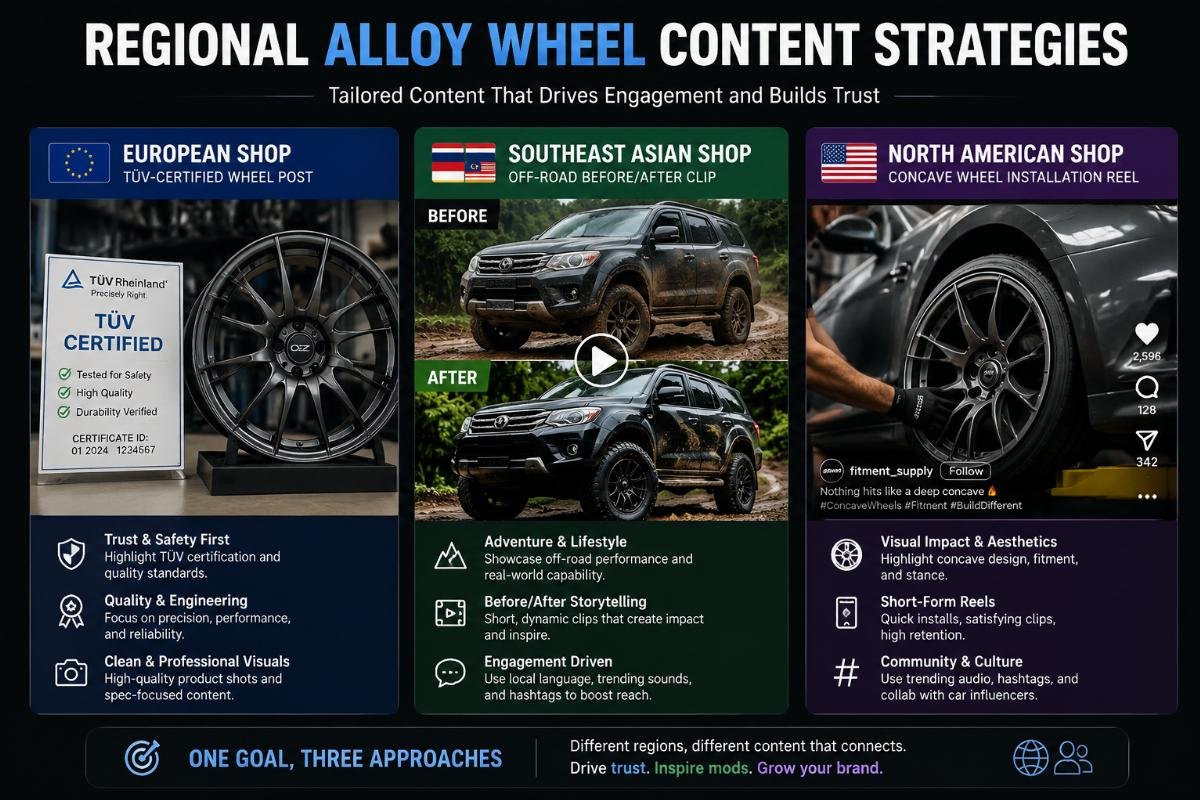
Tweaking your content and product offering to match regional market preferences lifts conversion rates by at least 100%. European customers prioritize certification and lightweight performance, Southeast Asian buyers prioritize fast delivery for off-road designs, and North American shops see the highest returns from deep-lip multi-spoke styles for passenger cars.
| Regional Market | Common Misaligned Offering | High-Performance Localized Adjustment |
|---|---|---|
| Europe | Generic uncertified wheel designs | TüV-certified lightweight flow-formed wheels with custom color options |
| Southeast Asia | Low-load capacity passenger car wheels | 17-22 inch heavy-duty off-road wheels with fast 15-day delivery |
| North America | Basic budget entry-level wheel designs | 18-24 inch concave deep-lip multi-spoke wheels for common sedan and SUV models |
A German modification shop focused exclusively on TüV-certified lightweight flow-formed wheels with custom paint and finish options for luxury German car owners, and saw their average high-end modification project ticket rise by 60% within 3 months of launching their targeted content strategy. [NEED_CITE: Region-specific content and product alignment doubles conversion rates for global modification shops]
- Local Vehicle Mapping – List the top 5 most common vehicle models that come into your shop for modification work
- Content Template Build – Create 3 reusable before/after and installation clip templates that work for your core customer vehicle base
- Conversion CTA – Explicitly list compatible vehicle models, delivery timelines and all-in installation pricing in every post caption
Conclusion
Building a high-converting Instagram system for alloy wheel sales does not require large budgets or professional production teams. The core winning formula relies on ditching generic global content for real local installation footage, locking in a small set of low-MOQ test styles instead of overstocking hundreds of designs, and aligning both your content and product offering to the specific preferences of your local market. This framework cuts customer acquisition costs by a measurable margin while reducing inventory risk, and works for modification shops in every major global market without requiring any specialized resources beyond the workflows they already use for day-to-day operations.
