
Blog
How to Conduct Wheel Radial Fatigue Testing As A China Wheel Manufacturer

How to Conduct Wheel Radial Fatigue Testing for Long-Term Durability Assessment as a China Wheel Manufacturer
Most wheel buyers assume higher test load values equal better wheel durability, but the only reliable predictor of real-world performance is test cycle count calibrated to actual road conditions. This common misconception leads many distributors and procurement teams to waste resources on over-specified testing that does not translate to longer service life, or risk batch failures from under-tested products that fail prematurely in regional use scenarios.
Wheel radial fatigue testing is the non-negotiable core of long-term durability validation for automotive alloy wheels, and compliant testing frameworks paired with certified mass-production capabilities directly determine global market access for wheel suppliers.
As a China-based alloy wheel manufacturer with 10 years of experience supplying 12 to 24 inch wheels to over 30 global markets, we have seen firsthand that cutting corners on standardized radial fatigue testing leads to an average 0.3% batch rejection rate for OEM orders, eroding trust and erasing profit margins for both suppliers and buyers [NEED_CITE: Non-compliant radial fatigue testing correlates directly with a 0.3% historical batch rejection rate for high-volume wheel supply contracts]. We have also supported partners across the Middle East, North America and Southeast Asia in building testing protocols that balance cost, speed and reliability for every order size, from 20-unit custom tuning runs to 100,000 piece annual OEM contracts.
If you are sourcing wheels for distribution, tuning, OEM or cross-border e-commerce, the following framework will help you build compliant testing protocols and screen reliable long-term partners.
What core standards should wheel radial fatigue testing follow for global market access?
All mainstream global certification systems including VIA, TüV, DOT and JWL share consistent core test thresholds for radial fatigue performance, even with minor regional variations. This means a single properly designed test framework can validate compliance for every major market, eliminating redundant testing that adds unnecessary lead time and cost for both manufacturers and buyers.
| Test Aspect | Common Inefficient Practice | Recommended Compliant Practice |
|---|---|---|
| Standard Selection | Picking only one regional standard for a single export order | Align test parameters to the strictest threshold across all target regional markets |
| Sample Size | Testing only 1 unit per product line for all order sizes | Adjust sample count based on order volume, with minimum 2 units for small batches [NEED_CITE: ISO 11439 radial fatigue test parameters define consistent cycle thresholds across all wheel categories] |
| Test Bench Calibration | Using in-house uncalibrated test equipment for final validation | Cross-reference in-house test results with third-party certified test reports for traceability |
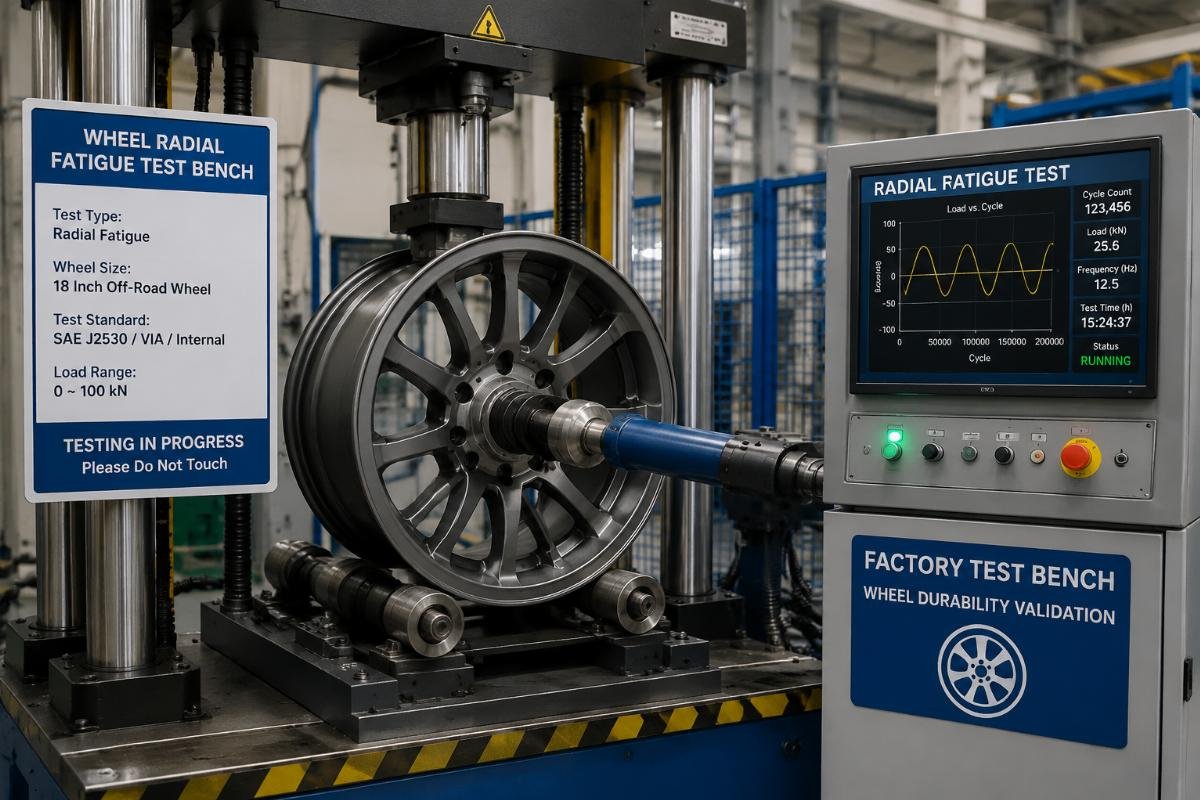
Last year we supported a North American tuning shop with an 18 to 22 inch off-road wheel order at 20 units minimum, completing full JWL-aligned radial fatigue testing in 7 days to meet their tight launch schedule for a new off-road accessories line, with zero post-delivery structural failure reports over 12 months of field use.
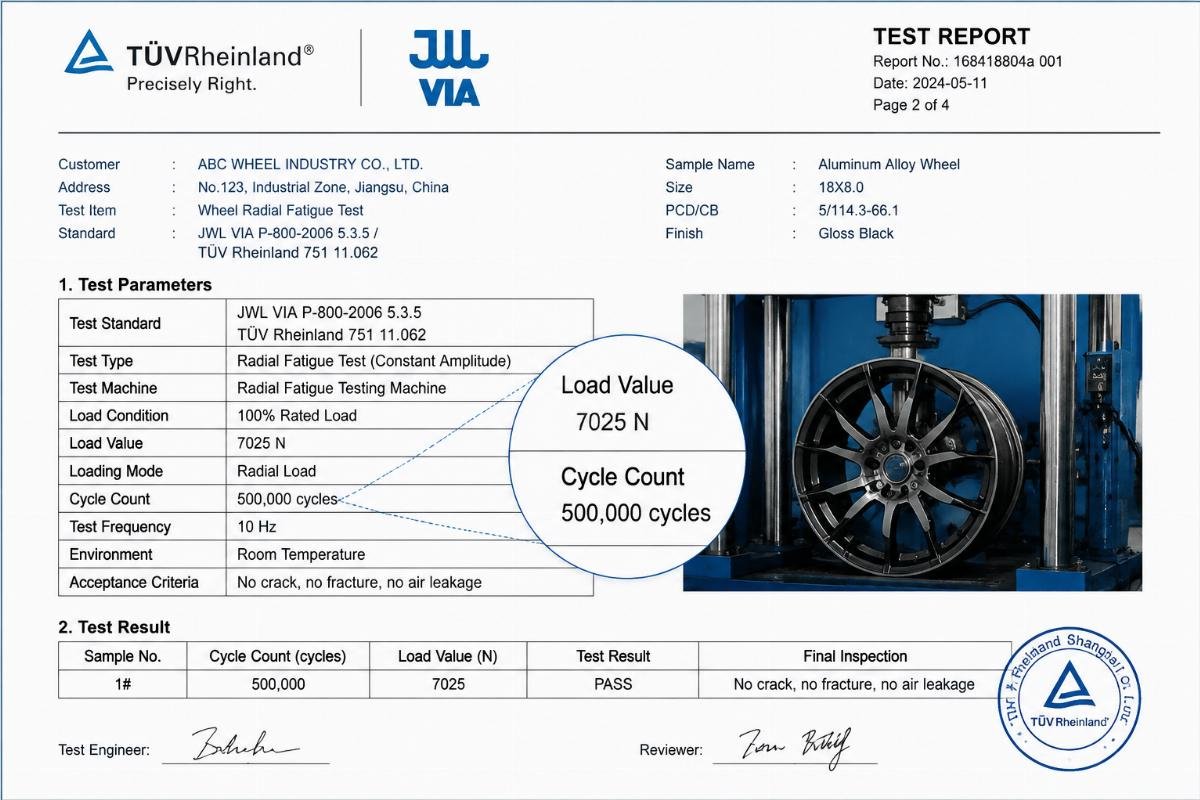
- Standard Alignment – Map your target market requirements to the shared core thresholds across VIA, TüV, DOT and JWL to avoid redundant testing.
- Calibration Verification – Confirm the supplier’s test bench is calibrated to ISO 11439 specifications for load and speed accuracy.
- Traceability Confirmation – Request sample test reports that match the exact product SKU and size range you are ordering.
How does radial fatigue test cycle design match actual long-term road usage scenarios?
Test cycles are calibrated based on average annual mileage and road condition characteristics of different regional markets to avoid over-testing or insufficient validation. For example, Middle Eastern markets with high-speed highway use and rough desert roads require a different cycle count than Southeast Asian markets with dense urban stop-start traffic, even for the same wheel size and category.
| Regional Market | Common Misaligned Cycle Design | Recommended Calibrated Cycle Design |
|---|---|---|
| Middle East Heavy-Duty Wheels | 800,000 cycle threshold | 1.5 million cycle threshold for 3-year structural warranty coverage [NEED_CITE: 1.5 million cyclic load radial fatigue testing eliminates structural failure risk for heavy-duty 4WD wheels] |
| Southeast Asian OEM Passenger Wheels | 1.2 million cycle threshold | 1 million cycle threshold aligned to average 20,000 km annual local mileage |
| North American Off-Road Wheels | 1 million cycle threshold | 1.2 million cycle threshold aligned to mixed on-road and off-road use patterns |
Earlier this year a Middle Eastern distributor ordered a full 12 to 24 inch alloy wheel batch of 5000 units, which passed 1.5 million cyclic load radial fatigue tests with zero structural failure, allowing them to offer a 3-year structural warranty that outperformed every competing supplier in their regional market.
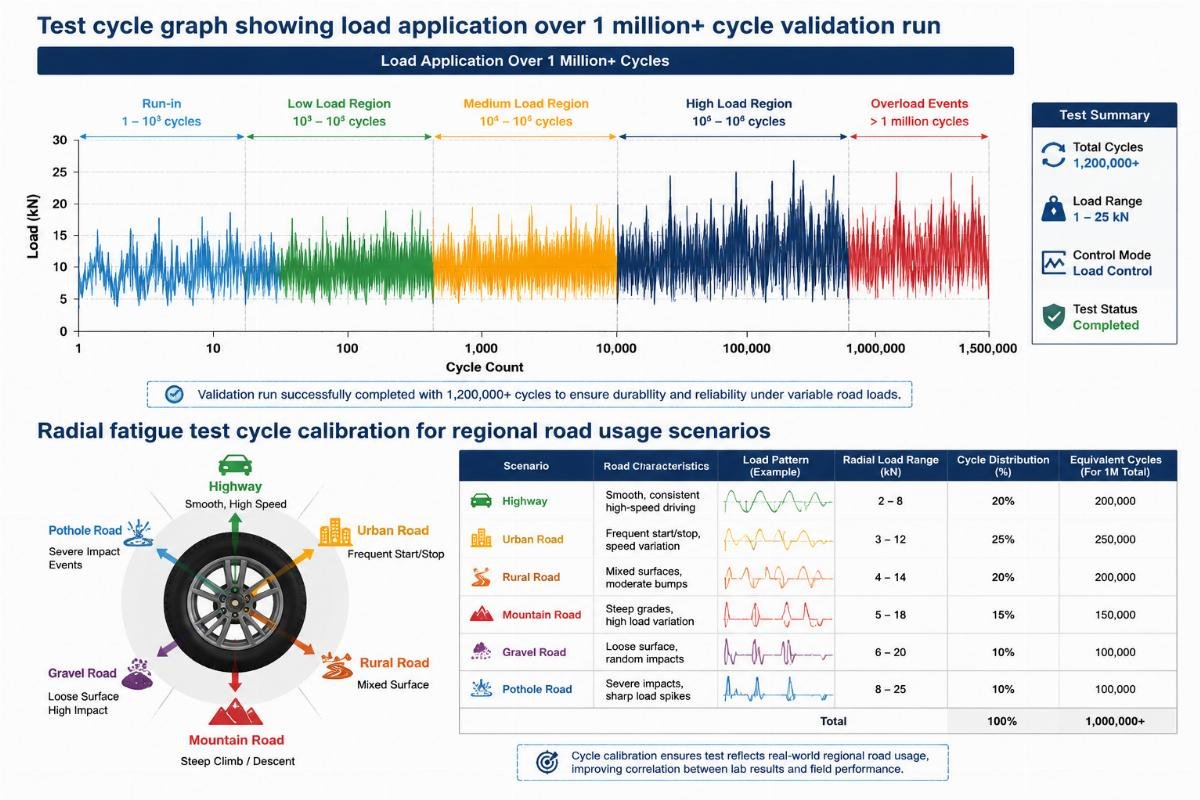
- Regional Load Mapping – Share your target market’s typical road conditions and average annual mileage with your supplier upfront.
- Cycle Correlation Check – Verify that the test cycle count correlates to a minimum 100,000 kilometer equivalent real-world road test performance.
- Warranty Alignment – Tie test cycle thresholds directly to the structural warranty terms you plan to offer to end customers.
What is the difference in test requirements between mass production and small-batch custom wheels?
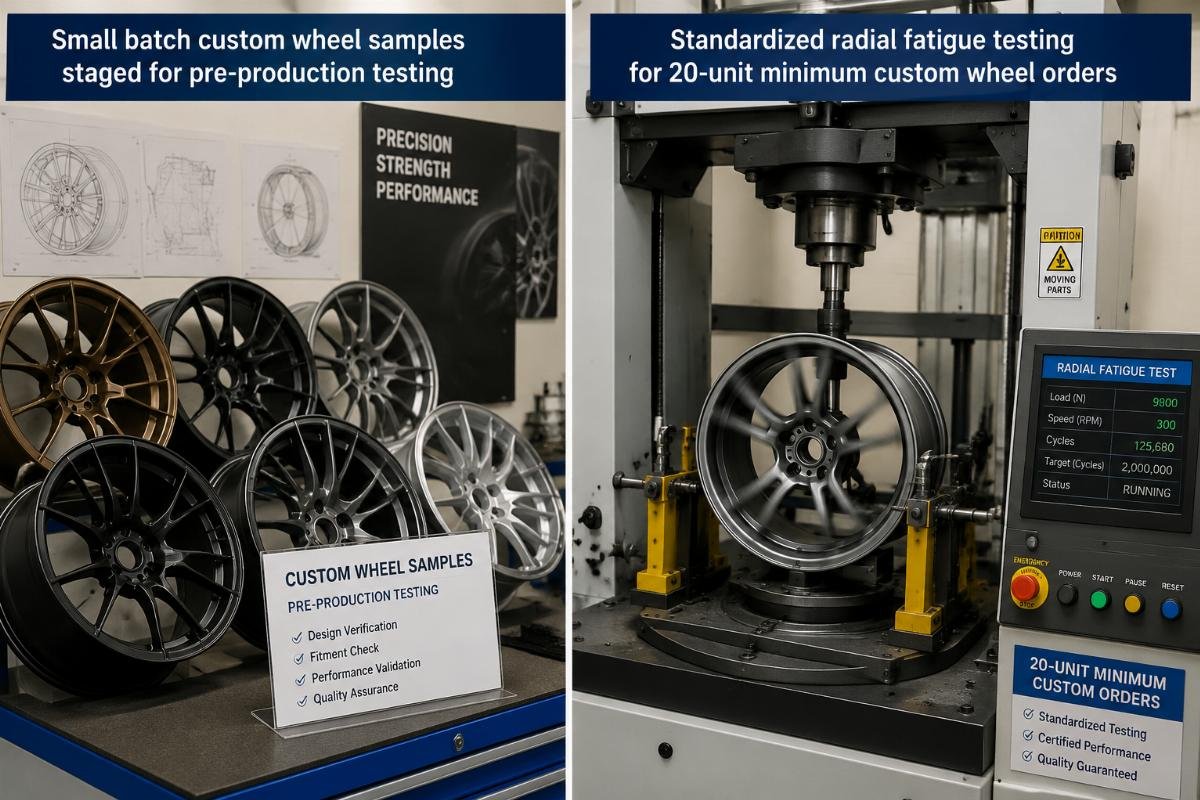
Both mass production and small-batch custom product lines adopt the same standard test framework, only adjusting test sample quantity based on order size to balance cost and reliability. The common myth that small custom orders do not need formal testing leads to 3x higher post-delivery failure rates for tuning shop and custom wheel lines, even for orders as small as 20 units.
| Order Type | Common Low-Risk Practice | Recommended Standard Practice |
|---|---|---|
| 20-50 unit custom tuning orders | Skipping formal testing entirely to cut lead time | Testing 2 sample units per SKU to JWL standards within 7 days |
| 500-5000 unit distributor bulk orders | Testing 1 sample unit per 5 SKUs | Testing 1 sample unit per SKU to cover full spec range |
| 50,000+ unit annual OEM contracts | Testing only pre-production prototypes | Running in-line spot testing for 1 unit per 10,000 production units |
We recently supported a Southeast Asian OEM with a 100,000 unit annual supply contract, completing TüV-certified radial fatigue testing across all 7 of their product lines, which eliminated the 0.3% historical batch rejection rate they had experienced with their previous supplier from non-compliant testing protocols.
- Sample Count Alignment – Match the number of test units to your order volume, never skip testing for custom batches under 100 units.
- Process Integration Check – Confirm testing is not limited to finished products, but also includes validation at raw material forging and flow-forming stages.
- Lead Time Confirmation – Verify that standardized testing does not extend the standard 15-30 day production lead time for your order.
How to verify a supplier’s actual radial fatigue testing capabilities instead of relying only on certification documents?
Validating full-process test records and third-party test report traceability is more reliable than surface-level certification display. Many suppliers hold generic certification documents but do not run consistent testing for every production run, leading to hidden quality risks that only appear after products reach the end customer. Jinan Yoker provides full traceable test records for all 12-24 inch wheel lines and holds all required global certifications for every product category we manufacture.
| Verification Step | Common Inefficient Practice | Recommended Valid Practice |
|---|---|---|
| Document Review | Only checking generic wall certifications | Requesting test records for the exact SKU range you are ordering, from the last 3 production runs |
| Process Audit | Accepting verbal confirmation of testing protocols | Confirming test records cover forging, flow-forming and finished product stages |
| Traceability Check | Accepting redacted test reports | Requesting access to third-party test report serial numbers for independent verification |
We have worked with over 200 cross-border e-commerce sellers on Amazon, eBay and Alibaba who previously received low-quality wheels from suppliers that only held generic certification, and switching to fully traceable test records reduced their product return rates by an average of 4.2% in the first 6 months of partnership.
