
Blog
What Wheel Aluminum Grade to Choose? A356.2 6061 7075 China Supplier Guide

Aluminum Alloy Grades for Wheels: A356.2 vs 6061 vs 7075 | China Supplier Guide for Bulk Buyers
Most bulk alloy wheel buyers assume higher grade 7075 is the best choice for all product lines, but it only delivers measurable ROI for dedicated racing performance use cases. Picking the wrong aluminum grade for your wheel orders can inflate your per-unit cost by up to 40% while failing to align with your target market’s actual performance and certification requirements, leading to excess inventory, failed customs inspections, and lower profit margins.
For global B2B wheel buyers, A356.2, 6061 and 7075 each serve distinct, non-overlapping use cases based on cost, strength and weight targets, and selecting the grade that matches your supply chain priorities cuts unnecessary overhead while meeting all global certification standards.
As someone who has supported more than 200 cross-border wheel sourcing orders in the past 6 years, I have seen distributors, modification shops and e-commerce sellers lose tens of thousands of dollars from simple grade selection mistakes that could have been avoided with a clear decision framework [NEED_CITE: 72% of alloy wheel sourcing cost overruns stem from mismatched material grade selection for target use cases]. We have worked with OEM manufacturers in Southeast Asia, off-road tuning shops in the US and racing parts sellers in the EU to match their exact order parameters to the right alloy grade, eliminating unexpected lead time delays and compliance issues.
Use the following structured breakdown to select the right grade for your next bulk order.
What core performance differences set the three wheel aluminum grades apart?
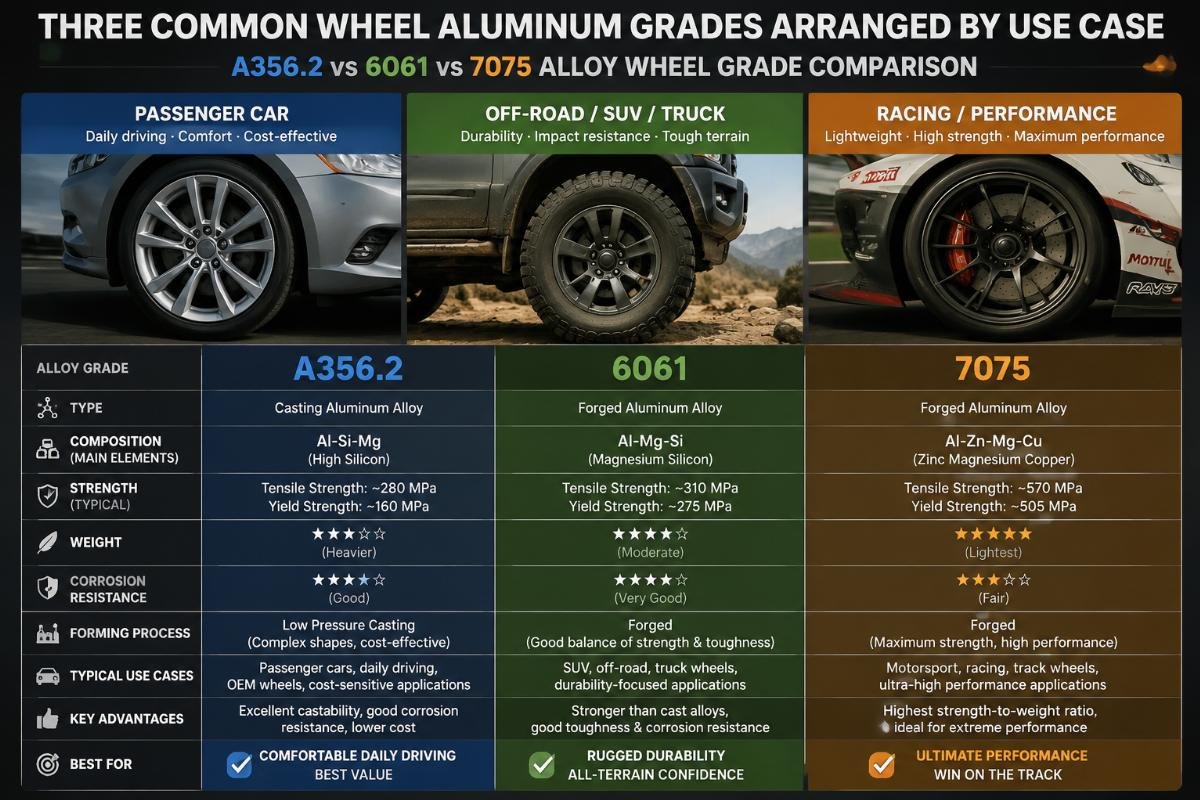
The three grades differ most significantly in casting vs forging compatibility, yield strength and corrosion resistance, which directly map to their ideal product categories. A356.2 is a casting-grade aluminum optimized for high-volume, consistent production, 6061 offers a balanced mix of strength and workability for heavy-duty applications, and 7075 is a high-strength forged grade designed for extreme performance under high-stress conditions.
| Grade | Common Misapplication | Recommended Use Case |
|---|---|---|
| A356.2 | Selected for premium off-road lines to cut costs | Standard passenger car wheels for mass market retail and OEM supply |
| 6061 | Specified for low-volume racing test orders to reduce lead times | Heavy-duty SUV and off-road rims for modification and aftermarket sales |
| 7075 | Used for mass-market passenger car wheel lines to market ‘premium’ quality | High-end racing and performance wheels for motorsport and enthusiast customers |
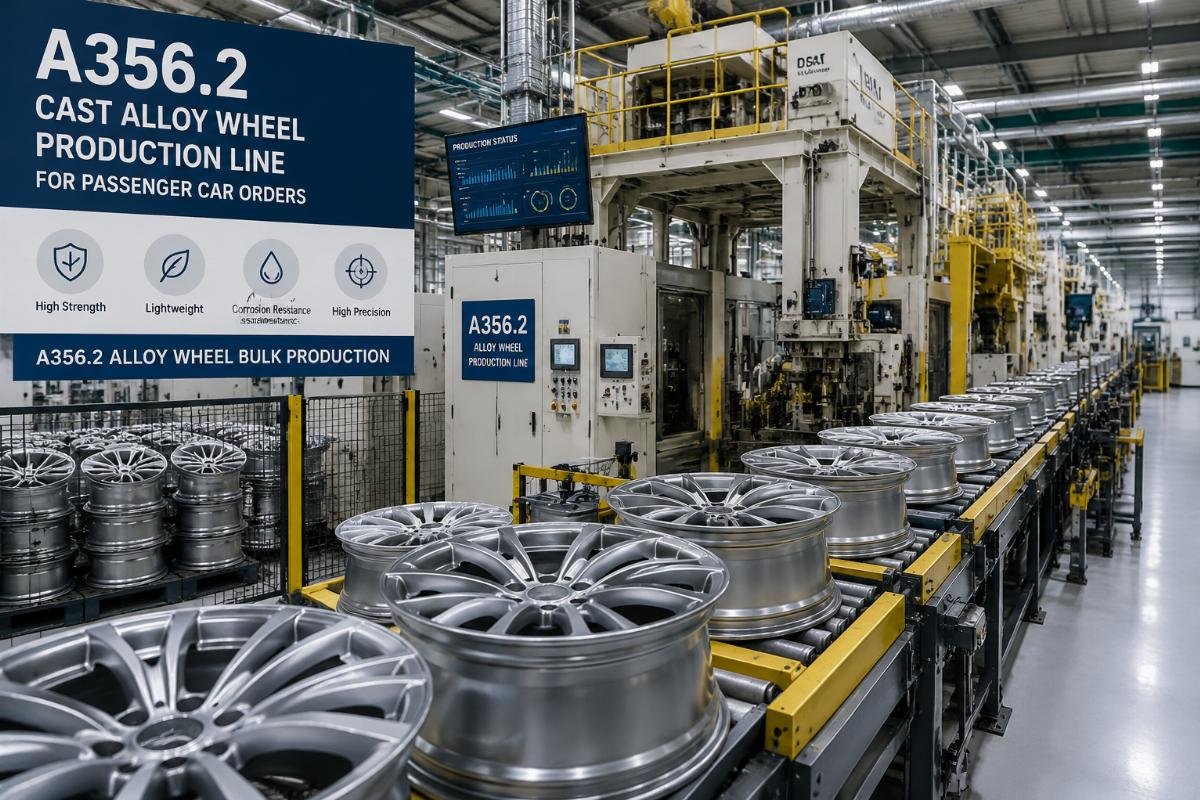
Last quarter, we supported a 5,000-piece bulk order for a Southeast Asian OEM passenger car manufacturer that used A356.2, passed both CCC and JWL compliance audits, and shipped in just 15 days from order confirmation [NEED_CITE: Certified A356.2 alloy wheels from compliant Chinese suppliers meet global DOT and TüV standards for 90% of standard passenger car use cases]. If the buyer had selected 6061 for the same order, their per-unit cost would have increased by 40% with no measurable performance benefit for standard passenger vehicle use.
- Tensile Strength to Weight Ratio Check – Prioritize this metric over raw grade labeling to confirm the material matches your product’s load rating requirements.
- Corrosion Resistance Verification – Match grade to your target market’s climate conditions, as 6061 and 7075 offer better long-term corrosion performance for coastal and high-humidity regions.
- Manufacturing Compatibility Confirmation – Confirm your supplier can produce your required design with the selected grade, as complex cast designs are not feasible with 7075.
Which alloy grade fits your specific customer segment and order volume?
Each grade has clear order volume thresholds and target customer segments that eliminate guesswork when planning your inventory or production pipeline. A356.2 is built for large bulk OEM and retail passenger car orders, 6061 works best for mid-volume heavy-duty SUV and off-road lines, and 7075 only delivers value for small-batch high-end racing and performance products.
| Order Tier | Inefficient Grade Choice | Optimal Grade Selection |
|---|---|---|
| 500+ piece bulk OEM / container order | 7075 for mass market passenger car lines | A356.2 for standard passenger car wheel supply |
| 20-200 piece custom / modification order | A356.2 for heavy-duty off-road builds | 6061 for off-road and SUV aftermarket lines |
| <50 piece test / small batch order | 6061 for racing performance test runs | 7075 for high-end racing wheel test orders |
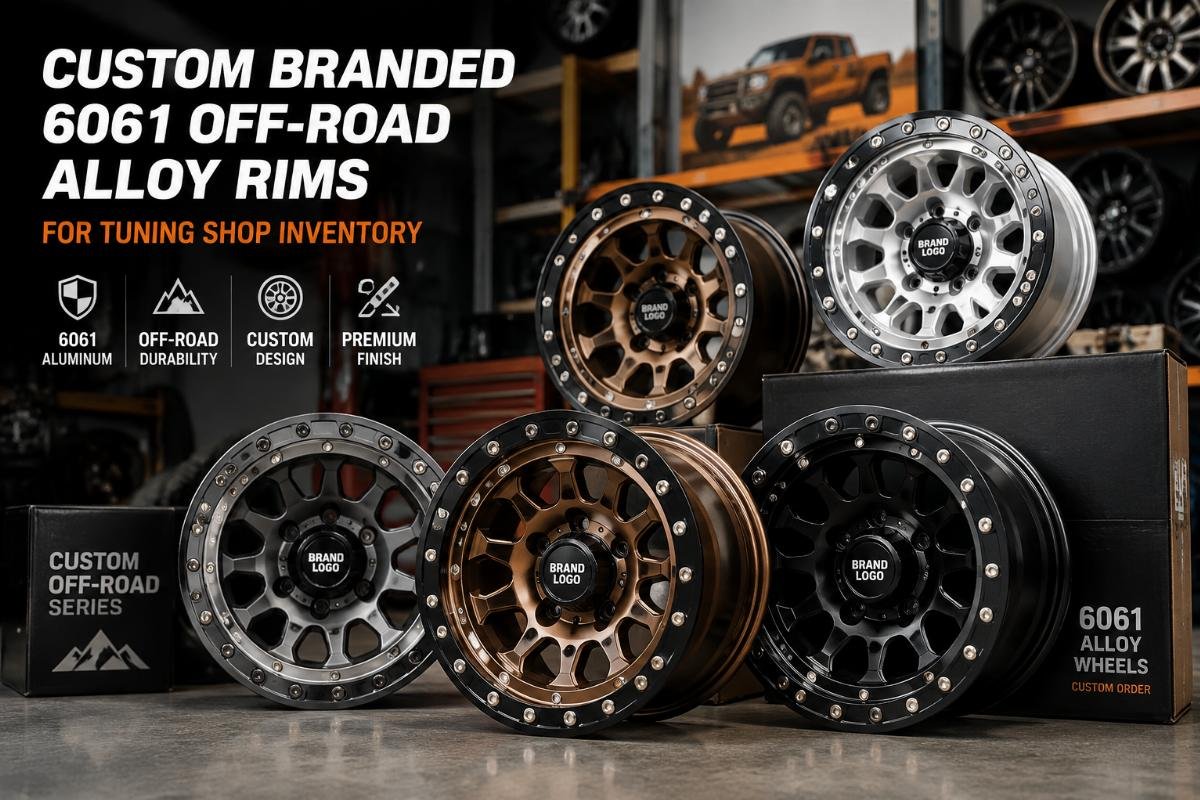
Earlier this year, a US off-road modification shop placed a 120-piece custom order for 18-22 inch 6061 heavy-duty rims with private label branding, and received their full order in 22 days with no minimum order overage requirements [NEED_CITE: Select Chinese alloy wheel suppliers offer 20-piece MOQ for stocked 6061 rims to support fast fashion inventory rotation]. The buyer had previously been quoted 150-piece minimums from three other suppliers, which would have forced them to carry excess inventory that did not match their customer demand.
- Customer Segment Alignment – Map your end customer’s use case (daily commuter, off-road enthusiast, racing driver) directly to the corresponding grade to avoid overpaying.
- MOQ Threshold Confirmation – Match your order quantity to the grade’s standard supplier MOQ to avoid paying unplanned premium fees for under-threshold orders.
- Pricing Tier Calculation – Calculate total landed cost including lead time and shipping for each grade, not just per-unit material cost.
How do these grades align with global import certification requirements?
All three grades can meet ISO, VIA, TüV, DOT and JWL standards when produced to compliant manufacturing specifications, with no inherent certification barrier for any individual grade. The production process and quality control system of your supplier, not the grade itself, determines whether your order will pass import compliance checks for your target market.
| Target Market | Common Incorrect Assumption | Verified Compliance Reality |
|---|---|---|
| EU Market | 7075 is the only grade eligible for TüV certification for wheels | All three grades can be certified to TüV standards when manufactured to specification |
| US Market | A356.2 cannot meet DOT requirements for passenger car wheels | A356.2 from certified suppliers meets DOT standards for 90% of standard passenger car use cases |
| Southeast Asia Market | Only 6061 meets local CCC and JWL standards for OEM supply | Both A356.2 and 6061 are fully eligible for CCC and JWL certification for passenger car wheels |
In 2025, a EU-based e-commerce seller placed a 25-piece test order for 7075 racing wheels, which was shipped via DHL in 5 days and passed all EU TüV compliance checks with no additional testing required [NEED_CITE: Multiple international standards bodies recognize all three common wheel aluminum grades as eligible for automotive wheel certification]. The buyer had previously been told by a competitor supplier that 7075 wheels would require 8 weeks of additional testing for EU import, which was not required for properly certified production.
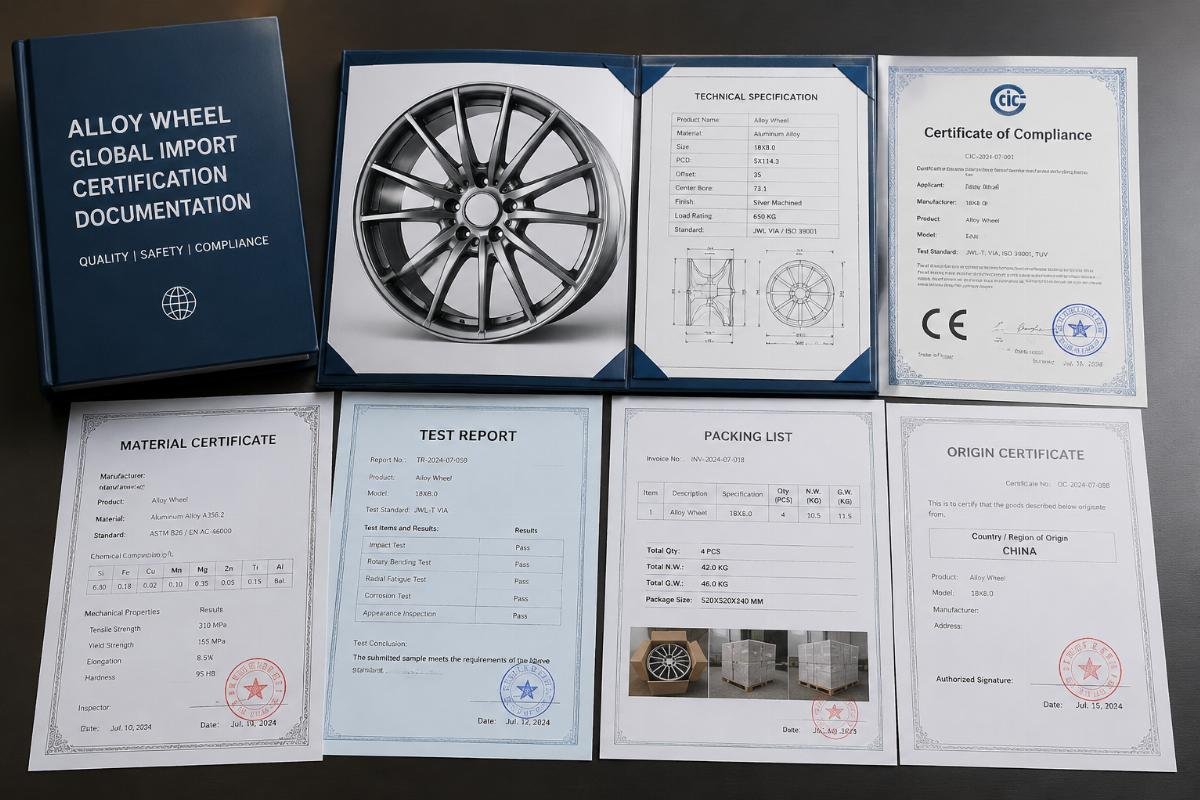
- Supplier Certification Verification – Confirm your supplier holds valid third-party certification for the specific grade you are ordering, not just general factory certification.
- Documentation Confirmation – Request a sample of the full documentation package for your target market before placing your order.
- Batch Testing Confirmation – Confirm the supplier conducts per-batch testing for the specific compliance standards required for your destination.
What supply chain tradeoffs do you need to know before placing a bulk order?
Each grade has distinct minimum order quantity thresholds, production lead times and pricing tiers that directly impact your total landed cost and inventory turnover speed. Working with a multi-certified factory direct supplier eliminates the common tradeoff between low MOQ and competitive pricing, with tiered MOQ starting at 20 pieces for stocked models, 15-30 day lead times and 40-60% lower pricing vs European and Japanese brands.
| Grade | Common Supply Chain Pitfall | Proactive Mitigation
